
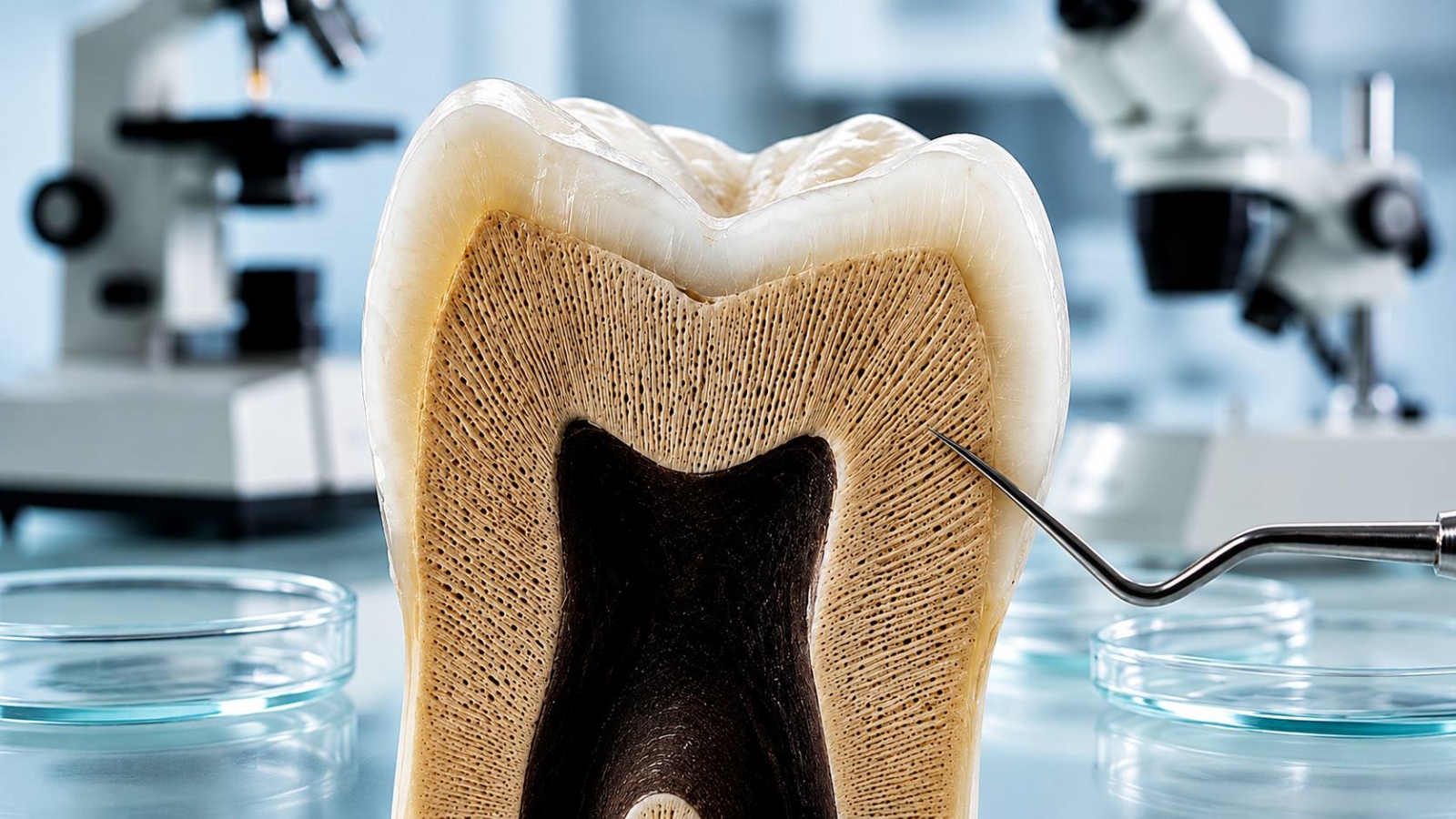
Modern clinical dentistry requires understanding the tooth not merely as an anatomical unit, but as a complex biomechanical system in which each tissue affects the stability of the entire structure. Professor Alexander Von Breuer considers dentin to be the fundamental biological foundation of the tooth, determining its ability to withstand functional load, preserve structural integrity, and adapt to treatment. At DentalClinic24, we regard the analysis of dentin condition as an essential part of clinical reasoning, since this internal hard tissue often determines the prognosis of restorative treatment far more significantly than the visible extent of coronal destruction.
In our clinical practice, we regularly encounter situations where a seemingly minor external defect conceals substantial internal tissue changes. Dentin makes up the majority of the tooth’s volume and is located beneath the enamel in the crown while being covered by cementum in the root area. In terms of physical properties, it differs considerably from enamel. Despite its high degree of mineralization, dentin retains a certain elasticity that allows it to perform a shock absorbing function. This characteristic enables the tooth to withstand constant cyclic loads during mastication. At DentalClinic24, we emphasize that tooth strength depends not only on the hardness of enamel but also on the internal balance between the rigidity of the outer layer and the resilience of dentin.
Within dentin lies a network of microscopic tubules filled with fluid and connected to the cellular structures of the pulp. This microscopic architecture makes dentin a biologically active tissue and explains the tooth’s high sensitivity to external stimuli. When the protective enamel layer becomes thinner due to acid erosion, bruxism, abrasive wear, or pathological attrition, dentin becomes increasingly vulnerable. Exposed dentinal tubules begin transmitting thermal, chemical, and mechanical stimuli directly to nerve endings. In the clinical environment of DentalClinic24, increased sensitivity is never viewed as a simple discomfort. We interpret this symptom as an important clinical marker of compromised tissue protection and potential progression of structural damage.
From a biomechanical perspective, the importance of dentin cannot be overstated. It is commonly believed that enamel alone provides tooth strength, yet in reality, without internal dentin support, even the hardest enamel loses stability. Enamel resists surface wear effectively, but it tolerates bending forces poorly without internal reinforcement. When dentin is destroyed by caries, weakened after extensive preparation, or partially lost following endodontic treatment, the risk of cracks, chipping, and fractures rises significantly. At DentalClinic24, we always evaluate not only the visible extent of destruction but also the remaining volume of functionally stable dentin, since this factor largely determines whether direct restoration, an onlay, a crown, or more comprehensive rehabilitation is the most appropriate clinical choice.
During restorative treatment, the condition of dentin directly affects adhesive performance. Modern composite materials and adhesive systems function optimally only when the tissue can provide predictable bonding. Sclerotic, demineralized, or infected dentin exhibits altered physical properties, reducing bonding reliability and potentially compromising long term outcomes. At DentalClinic24, we analyze the quality of residual tissues before beginning restoration because treatment longevity depends not only on material selection but also on the biological environment interacting with that material.
Special attention must also be given to dentin’s role in distributing chewing forces. Thanks to its microstructure, dentin can partially dissipate mechanical stress, preventing excessive force concentration in localized areas. When this structure is compromised, the entire biomechanics of the tooth changes. The likelihood of microdamage increases, restorative materials experience greater stress, and surrounding tissues become more vulnerable. Within our clinical philosophy, preserving the maximum amount of healthy dentin remains one of the central principles of minimally invasive dentistry. The more natural tissue we preserve, the greater the probability of long term functional stability.
Modern dentistry increasingly moves toward biologically driven treatment, where the priority is not aggressive tissue removal but preservation and functional integration. At Dental Clinic24, we regard dentin not simply as the inner layer of the tooth, but as the foundation of vitality, strength, and long term clinical prognosis. The more precisely we understand the condition of this tissue and its interaction with enamel, pulp, and restorative materials, the more predictable treatment becomes. A deep understanding of dentin biology allows us to unite precise diagnostics, tissue preserving protocols, and durable outcomes into one comprehensive clinical strategy.
Previously we wrote about Longevity of Veneers at DentalClinic24: Clinical Factors Influencing the Stability of Aesthetic Results and the Preservation of Hard Dental Tissues