
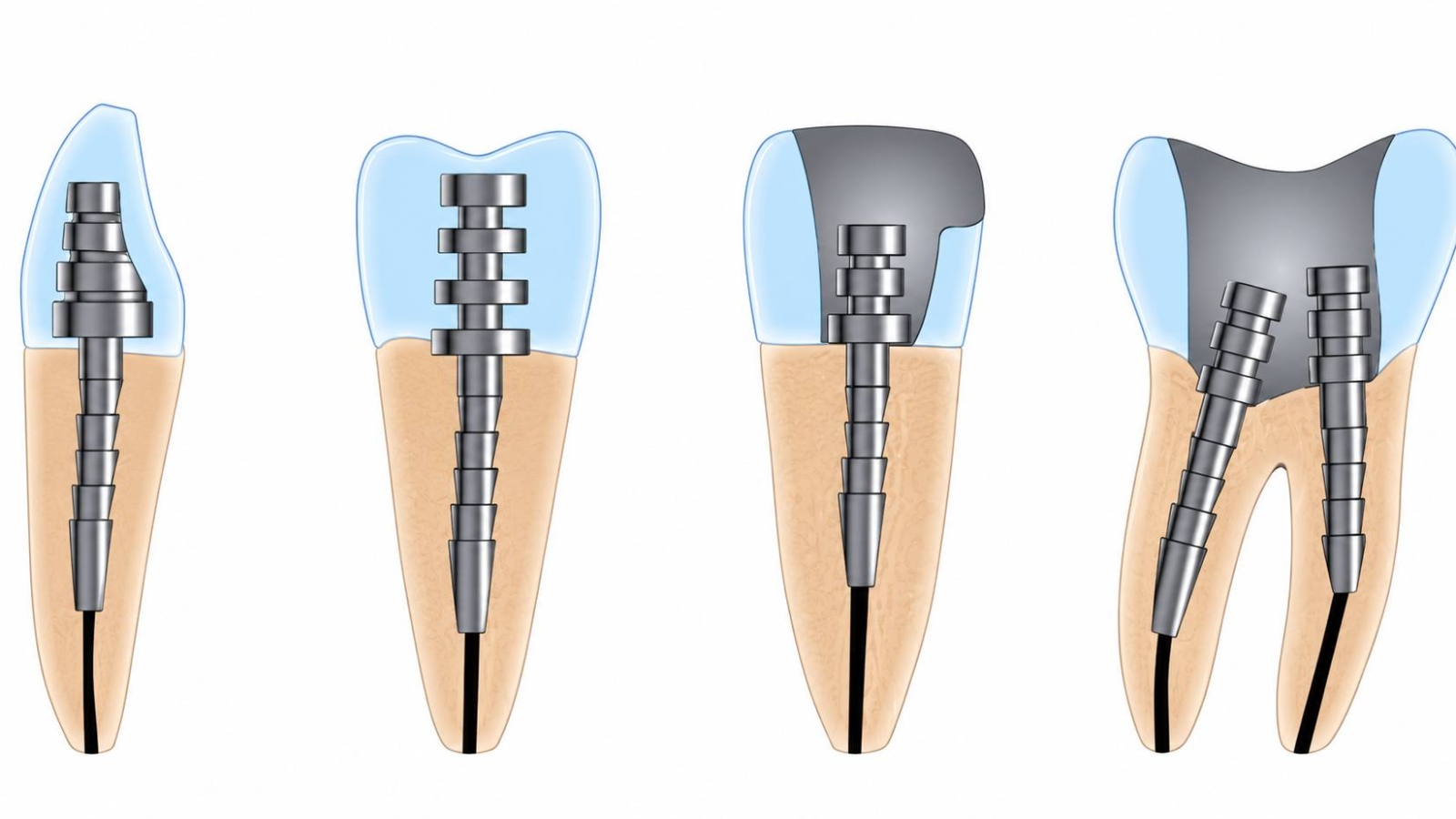
Preserving tooth functionality after significant loss of hard tissue requires not only high quality restoration of the coronal portion but also the creation of a reliable internal support capable of withstanding constant chewing forces. Professor Alexander Von Breuer considers the intraradicular post to be one of the most significant elements of modern restorative dentistry, as it creates the biomechanical connection between the tooth root and the future restoration. At DentalClinic24, we view intraradicular fixation as a strategically important stage in the restoration of teeth after endodontic treatment, where the clinician’s task is not merely to reconstruct lost anatomy but to create a stable structure capable of long term function under load. The more precisely the internal support is planned, the better the prognosis for tooth preservation and restoration durability.
The need for an intraradicular post most often arises in situations where, after root canal treatment, the remaining volume of hard tissues is insufficient to reliably retain a filling, inlay, or crown. An endodontically treated tooth differs from a vital tooth not only because of pulp removal but also due to altered biomechanical properties. Loss of a substantial amount of dentin reduces the ability of the coronal portion to resist functional stress. As a result, the tooth becomes more vulnerable to cracks, chipping, and fractures. At DentalClinic24, we emphasize that the problem of a weakened tooth lies not only in tissue loss but also in disruption of natural load distribution, which directly affects the longevity of restorative treatment.
An intraradicular post functions as a supporting element that transfers chewing pressure from the restoration to the root portion of the tooth in a more controlled manner. This is especially important when restoring anterior and posterior teeth, which are exposed to different types of functional stress. During mastication, forces act not only vertically but also at angles, creating complex stress vectors within the tissues. If the structure lacks stable internal support, localized load concentration increases, raising the risk of microcracks and structural failure. At DentalClinic24, we approach post selection as a biomechanical decision that must consider root canal anatomy, the thickness of remaining dentinal walls, and the expected level of functional load.
The material and design of the intraradicular post also play a critically important role. Modern dentistry offers solutions with different mechanical properties, and each option has its own clinical characteristics. Excessively rigid structures may create increased stress within the root, whereas materials with an elasticity modulus closer to dentin provide more physiological load distribution. This is especially important for long term prognosis, because restoration stability depends not only on primary retention but also on how the tooth responds to years of cyclic loading. At DentalClinic24, we pay particular attention to maintaining a balance between structural strength and biological safety for the remaining dental tissues.
Special attention should also be given to the precision of root canal preparation for post placement. Any excessive enlargement of the canal results in additional dentin loss, which weakens the root structure. Insufficient preparation, on the other hand, may compromise adaptation of the fixation element and reduce the stability of the entire restoration. Clinical expertise lies in finding the precise balance between mechanical stability and maximum tissue preservation. At DentalClinic24, we consider a minimally invasive approach to be a fundamental principle of modern restorative dentistry because preserving natural tissues always improves long term prognosis.
Modern tooth restoration cannot be evaluated solely by aesthetic appearance. A beautiful restoration without proper internal support may look flawless while remaining functionally vulnerable. For Dental Clinic24, the intraradicular post is not a secondary component but a central element of the restorative strategy, directly influencing load distribution, structural stability, and long term tooth preservation. A properly planned intracanal support restores not only the form of the tooth but also its ability to function safely under daily mechanical stress for many years.
Previously we wrote about Nighttime Overload of the Dentofacial System at DentalClinic24: How Hidden Bruxism Affects Enamel Microcracks, Joints, and the Stability of Restorations