
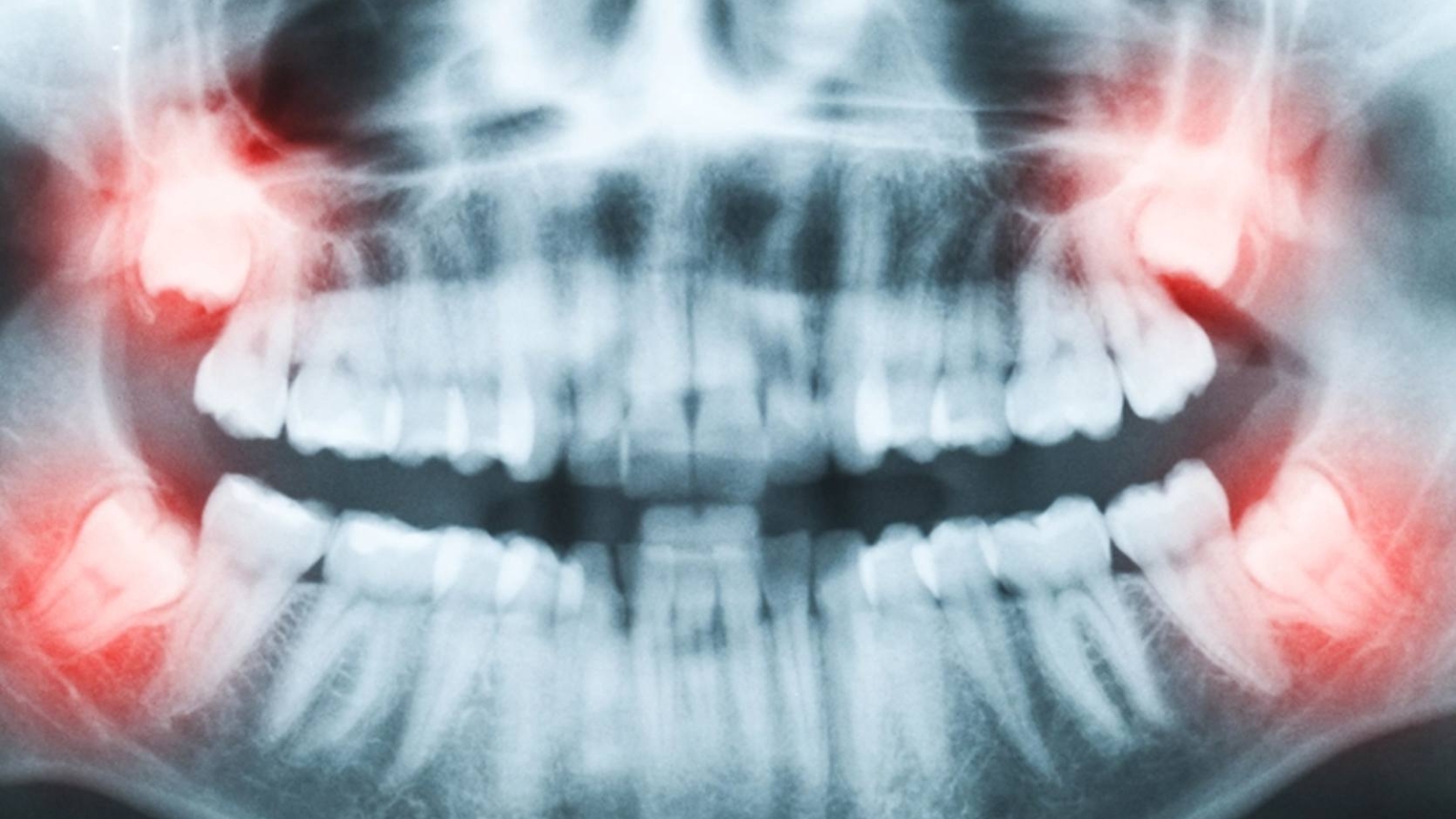
Impacted wisdom teeth are among the most common yet frequently underestimated clinical conditions in modern surgical dentistry. Professor Alexander Von Breuer considers this pathology a hidden source of chronic inflammation and functional imbalance, especially in cases where the tooth remains partially or completely embedded in bone or soft gingival tissue. At DentalClinic24, we view an impacted third molar not as an isolated anatomical feature but as a potential long term risk factor capable of affecting the entire dentofacial system. Early diagnosis and accurate clinical planning help prevent complications that may develop silently over many years.
Impaction refers to a condition in which a tooth fails to erupt within the expected time frame and remains in an abnormal position within the jaw. The causes may include insufficient space in the dental arch, improper eruption angle, dense bone structure, or anatomical obstruction caused by adjacent teeth. An impacted tooth may be positioned vertically, horizontally, distally, or mesially, and each of these clinical variations creates different risks for surrounding structures. At DentalClinic24, we emphasize that evaluating the position of a third molar requires not only visual examination but also high precision radiological diagnostics, including panoramic imaging and, when necessary, three dimensional computed tomography, since only these methods allow objective assessment of the relationship between roots, bone tissue, and neural structures.
One of the most common complications associated with impacted wisdom teeth is inflammation of surrounding tissues. A partially erupted tooth often creates what is known as a gingival hood, forming an area that is difficult to clean naturally. Bacterial plaque, food debris, and inflammatory mediators accumulate rapidly in this space, leading to the development of pericoronitis. Clinically, this may present as pain, swelling, restricted mouth opening, unpleasant breath, and even elevated body temperature. At DentalClinic24, we frequently observe patients who adapt to periodic discomfort and postpone treatment, even though the chronic inflammatory process continues to progress and places increasing stress on local immunity and soft tissues.
The influence of an impacted wisdom tooth on occlusion and spatial stability of the dental arch is equally significant. When positioned atypically, the wisdom tooth may exert continuous pressure on the second molar, causing displacement, rotation, or changes in contact surfaces. Over time, this may lead to crowding, bite disturbances, and redistribution of chewing load. These changes are especially relevant in patients who have undergone orthodontic treatment, where even minimal movement can compromise long term stability. At DentalClinic24, we assess every impacted tooth in the context of overall occlusal biomechanics because a localized issue often becomes the source of broader functional disturbances.
The hidden danger of impacted third molars also lies in their potential to damage adjacent structures. Constant pressure on the second molar may cause root resorption, enamel demineralization in the contact area, and secondary caries formation in hard to access zones. In some cases, cysts or other pathological lesions develop around the impacted tooth, accompanied by destruction of surrounding bone. At DentalClinic24, we place strong emphasis on preventive monitoring of such conditions because early detection of pathological changes significantly reduces the extent of future surgical intervention and lowers the risk of complications.
When clinical and radiological findings confirm a threat to the patient’s oral health, removal of the impacted tooth becomes a justified necessity. Surgical intervention requires detailed planning because the complexity of the procedure depends on tooth depth, root morphology, bone density, and proximity to critical anatomical structures. Modern surgical protocols allow tissue trauma to be minimized, postoperative swelling reduced, and healing accelerated. For Dental Clinic24, timely removal of an impacted wisdom tooth is not merely the extraction of a problematic structure but part of a broader strategy to preserve functional balance throughout the dentofacial system. Accurate diagnostics, precise planning, and an individualized approach help prevent chronic inflammation, protect adjacent teeth, and maintain long term occlusal stability.
Previously we wrote about Facial Changes After Bite Restoration in the DentalClinic24 Concept: The Influence of Occlusal Rehabilitation on Soft Tissues and Muscles