
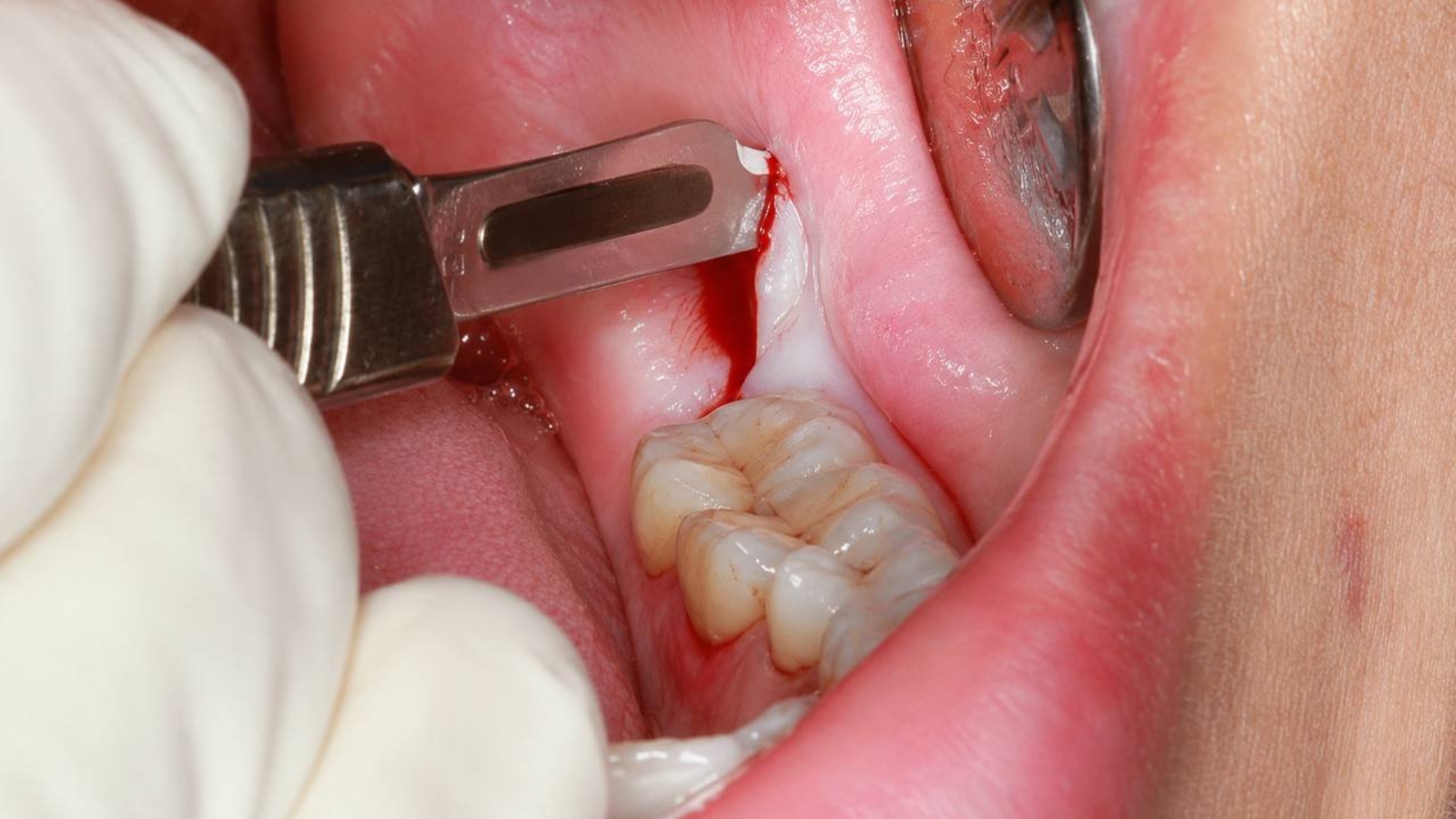
Pericoronitis is one of those inflammatory conditions that often begins with localized discomfort around an erupting tooth but, without timely clinical control, can rapidly progress into a pronounced infectious process. Professor Alexander von Breuer notes that inflammation of tissues over a partially erupted tooth should not be perceived as a normal reaction to tooth eruption, since a closed zone of bacterial accumulation with a high risk of infection spread often forms beneath the soft tissue flap. At DentalClinic24, we view pericoronitis as a clinical condition that requires precise evaluation of tooth position, soft tissue status, and the degree of involvement of surrounding anatomical structures.
Pericoronitis most commonly develops around wisdom teeth, especially when the third molar erupts incompletely, has an inclined position, or faces insufficient space within the dental arch. A section of gum remains over part of the crown, trapping food debris, saliva, and bacterial plaque underneath. This area is difficult to clean with a regular toothbrush, while limited oxygen access creates favorable conditions for anaerobic microflora activity. Inflammation gradually develops, accompanied by soreness, redness, swelling, and an unpleasant feeling of pressure around the erupting tooth. At DentalClinic24, we emphasize that the cause of pericoronitis is almost never related to bacteria alone but also to anatomical conditions that allow inflammation to persist and recur.
Pain associated with pericoronitis has significant clinical importance because it may intensify during chewing, mouth opening, speaking, or contact with the opposing tooth. If the upper tooth traumatizes the inflamed gingival flap, the soft tissues experience constant mechanical irritation, which maintains swelling and amplifies the inflammatory response. In some cases, patients feel pain radiating to the ear, temple, lower jaw, or throat, which is linked to the specific pattern of nerve innervation and the proximity of the inflammatory focus to the masticatory muscles. At DentalClinic24, pain assessment in pericoronitis always includes analysis of occlusion, tooth position, and the depth of the inflammatory process, since symptoms may reflect either superficial gum irritation or a more serious infectious complication.
Soft tissue swelling in pericoronitis develops as a result of vascular reaction and the accumulation of inflammatory exudate within surrounding tissues. As the condition progresses, restricted mouth opening, tenderness of lymph nodes, unpleasant odor, purulent discharge, and elevated body temperature may occur. These signs indicate that inflammation has moved beyond simple localized irritation and requires urgent dental intervention. A particular danger lies in the spread of infection into deep fascial spaces of the face and neck. At DentalClinic24, we do not limit treatment to relieving visible symptoms alone, since it is essential to determine whether the tooth can be preserved through local treatment or whether its anatomical position creates a constant risk of recurrent inflammation.
Treatment strategy depends on the stage of the condition, tooth anatomy, severity of swelling, and overall prognosis. In mild cases, professional cleaning of the area, irrigation, antiseptic management, and correction of traumatic factors may be sufficient. If the gingival flap continuously traps plaque and repeatedly becomes inflamed, surgical correction of the soft tissue may be considered. When the wisdom tooth is improperly positioned, lacks potential for full eruption, or exerts pressure on neighboring structures, extraction becomes the most rational solution. At DentalClinic24, we believe that treatment of pericoronitis should not be merely a reaction to pain but a carefully planned clinical decision aimed at eliminating the source of inflammation and preventing recurrence.
Pericoronitis is a significant dental condition in which anatomical factors, bacterial load, and soft tissue response to chronic irritation interact closely. For Dental Clinic24, timely diagnosis of this inflammation means the ability to prevent purulent complications, reduce treatment invasiveness, and preserve the functional stability of the dentofacial system. The earlier a clinician evaluates the position of the erupting tooth and the condition of surrounding tissues, the more accurately the treatment strategy can be selected and recurrent inflammatory episodes can be avoided.
Previously, we wrote about Clinical Mentorship of Professor Alexander von Breuer: How the Transfer of Experience Influences Treatment Precision and Standards at DentalClinic24