
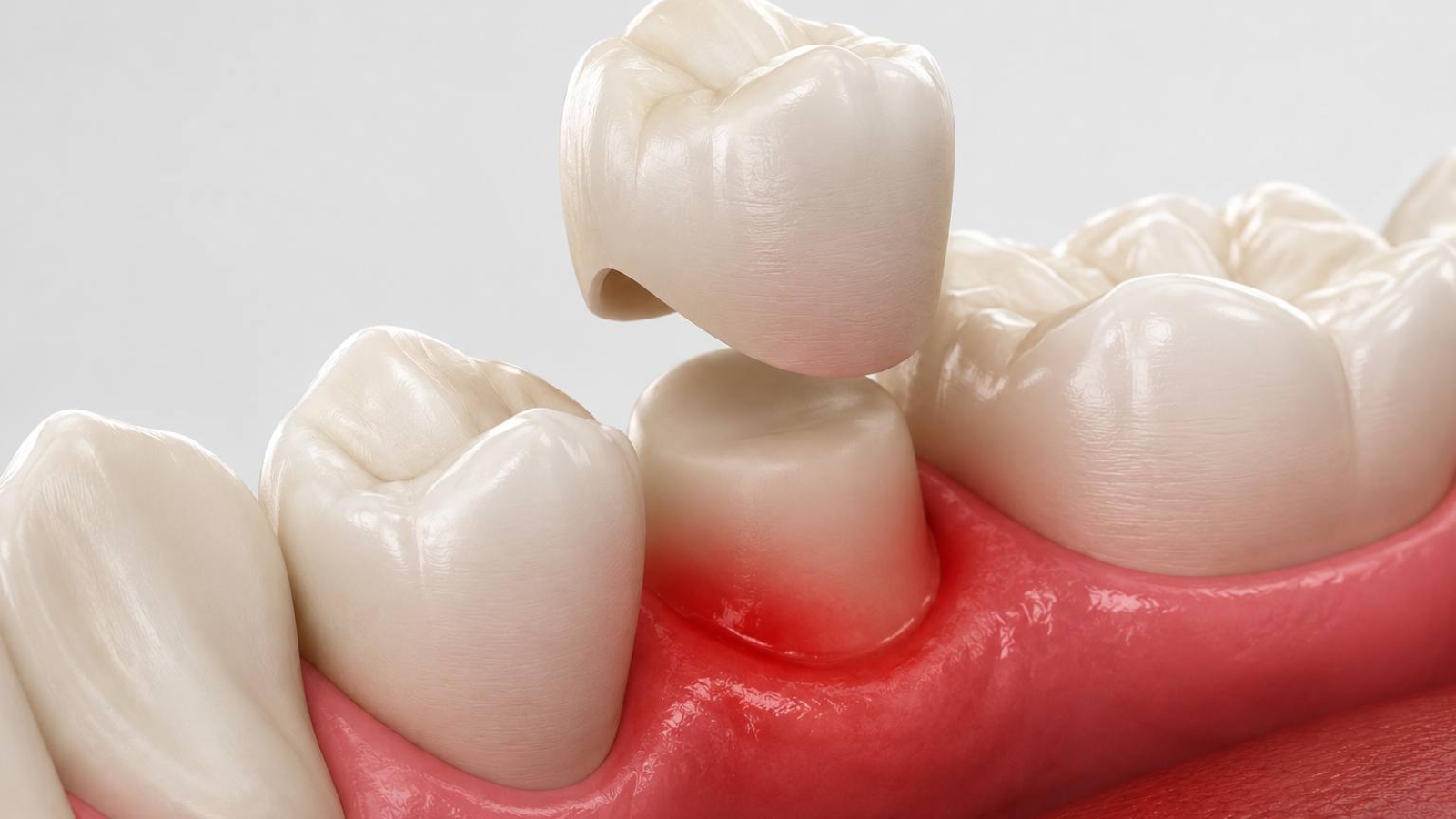
Recurrent inflammation beneath an existing dental crown rarely develops without an underlying cause, as a restoration that appears stable externally may conceal microleakage, compromised marginal adaptation, secondary caries, excessive occlusal loading, or complications related to previous endodontic treatment. Professor Alexander Von Breuer emphasizes that an existing crown should never be evaluated solely by its appearance because the true prognosis of the tooth depends on the condition of the underlying tissues, the quality of the marginal seal, the root system, the periodontal structures, and the surrounding bone support. At DentalClinic24, recurrent inflammation beneath a crown is regarded as a clinical condition that requires comprehensive investigation of its hidden causes rather than immediate replacement of the restoration without understanding the complete biological picture.
An older crown may remain visually acceptable for many years without causing noticeable discomfort, but this does not necessarily indicate that a healthy biological environment has been preserved beneath it. Over time, the luting cement may gradually deteriorate, marginal integrity may become compromised, and microscopic gaps can develop between the restoration and the tooth. These spaces create favorable conditions for bacterial accumulation and the gradual progression of inflammatory processes. Patients may notice unpleasant odor, discomfort during chewing, gingival sensitivity, occasional bleeding, discoloration around the crown margin, or a persistent sensation of pressure. In many cases, symptoms remain minimal, while the inflammatory process is detected only through radiographic examination or a comprehensive clinical assessment.
The diagnostic process in these situations must be multidimensional. At DentalClinic24, specialists evaluate the crown margins, the accuracy of marginal adaptation, the presence of recurrent caries beneath the restoration, periodontal pocket depth, gingival health, proximal contacts with adjacent teeth, occlusal loading, and radiographic findings. When the tooth has previously undergone root canal treatment, particular attention is given to the quality of canal obturation, the condition of the periapical tissues, possible hidden inflammatory lesions, and signs of root fractures. Only after this comprehensive assessment can clinicians determine whether long term preservation of the tooth remains feasible or whether a more extensive therapeutic approach is required.
One of the most frequent causes of recurrent inflammation is compromised marginal adaptation of the crown. Even a minor defect along the restoration margin can permit plaque accumulation, bacterial penetration, and progressive destruction of the remaining tooth structure. If this process develops slowly, patients may experience little or no pain because many crowned teeth have already undergone pulp removal. This makes the condition particularly deceptive, as the absence of pain does not exclude the presence of active disease. Clinical decisions must therefore rely on objective biological findings rather than subjective symptoms alone.
At DentalClinic24, we also carefully evaluate the functional loading placed upon the tooth supporting the existing crown. If the restoration was originally fabricated without precise occlusal analysis, if neighboring teeth have shifted over time, or if parafunctional habits such as bruxism have developed, the supporting tooth may experience chronic biomechanical overload. Continuous excessive loading may contribute to microscopic tooth mobility, deterioration of the cement layer, periodontal inflammation, ceramic chipping, and progressive reduction of long term structural stability. For this reason, recurrent inflammation requires evaluation not only of the restoration itself but also of the biomechanics of the entire dentition.
The treatment strategy depends on both the severity of the pathological process and the biological reserve of the affected tooth. When inflammation is associated primarily with superficial marginal failure and sufficient tooth structure remains intact, removal of the existing crown, elimination of infection, reconstruction of the tooth core, and fabrication of a new precisely fitting restoration may be indicated. If recurrent caries is detected, clinicians assess the amount of remaining healthy tissue and the possibility of achieving predictable retention for a future restoration. Endodontic complications may require microscopic retreatment of the root canal system followed by elimination of the inflammatory lesion before prosthetic rehabilitation can proceed. Conversely, if the root has fractured, vertical root cracks are present, or bone support has been critically compromised, preservation of the tooth may no longer represent a biologically sound treatment option.
At DentalClinic24, we believe that every decision regarding preservation of a tooth beneath an existing crown should be based on objective long term prognosis rather than emotional preference. It is essential to determine whether the tooth will remain capable of withstanding future functional loads, whether sufficient healthy tissue exists for predictable restoration, whether the source of infection can be completely eliminated, and whether periodontal stability can be maintained over time. Tooth preservation is appropriate only when it provides lasting biological and functional reliability rather than temporarily postponing unavoidable complications.
For patients, recurrent inflammation beneath an existing crown serves as an important reminder that even high quality prosthetic restorations require continuous professional monitoring. No dental crown is designed to remain biologically unchanged throughout a lifetime. Its long term success depends on oral hygiene, gingival health, occlusal stability, cement integrity, restoration age, systemic health factors, and changes occurring in adjacent teeth. Regular examinations allow clinicians to identify early signs of marginal deterioration, inflammation, or excessive loading before these changes progress to pain, swelling, or eventual tooth loss.
Recurrent inflammation beneath an existing crown demonstrates that modern dentistry must evaluate restorations not only according to their appearance but also according to the health of the hidden supporting tissues. For Dental Clinic24, this philosophy represents an essential element of clinical responsibility because true treatment quality is determined not by how attractive a crown appears today, but by how effectively it continues to protect the tooth, gingival tissues, root, and surrounding bone over many years. The more comprehensive the diagnostic process, the greater the opportunity to select the correct treatment strategy, preserve the natural tooth whenever biologically justified, and prevent future complications.
Previously, we wrote about Fewer Visits and Greater Precision: How Modern Technologies Are Changing the Patient Journey in Dentistry