
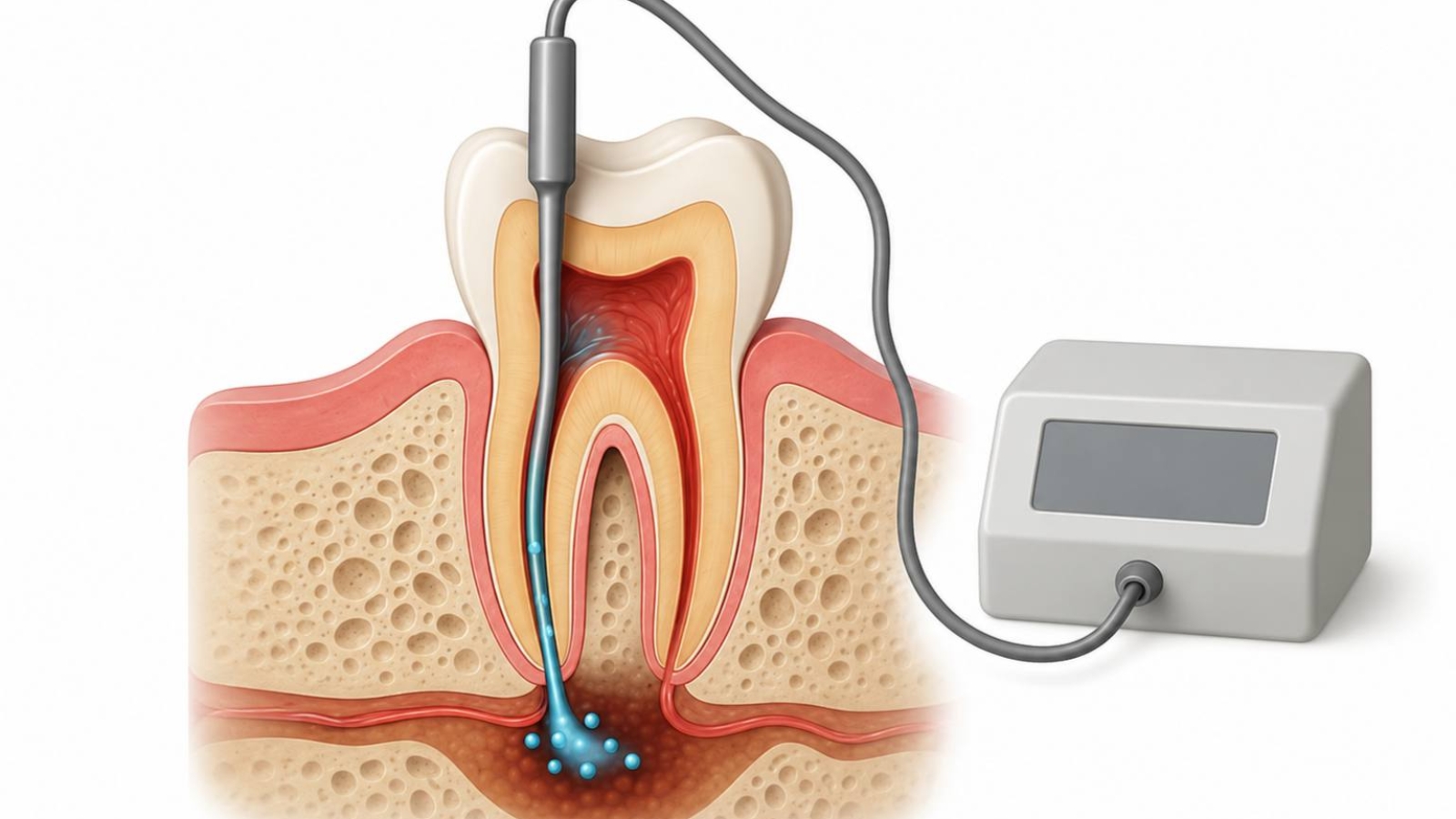
Modern endodontic treatment is no longer limited to the mechanical preparation of root canals because the long term success of tooth preservation largely depends on the quality of microbial elimination throughout the entire root canal system. Professor Alexander Von Breuer analyzes contemporary endodontic disinfection methods as one of the key determinants of predictable clinical outcomes, emphasizing that conventional techniques are not always capable of completely eliminating bacterial contamination. At DentalClinic24, we regard depophoresis as an advanced clinical technology that expands the possibilities of preserving teeth with complex root canal anatomy, recurrent inflammatory conditions, and anatomical areas that remain inaccessible to standard instrumentation. This approach allows treatment to extend beyond the primary canal and reach numerous lateral branches where microorganisms may continue to survive and sustain chronic inflammation of the surrounding tissues.
The anatomy of every root canal system is unique. In addition to the main canal, teeth often contain accessory canals, lateral branches, anastomoses, dentinal tubules, and microscopic anatomical structures that cannot be thoroughly cleaned using mechanical instruments alone. Even after complete removal of infected pulp tissue, bacteria may remain within these inaccessible areas. Under favorable conditions these microorganisms continue to multiply, maintaining inflammatory processes that may eventually result in chronic apical periodontitis, cyst like lesions, or reinfection of a previously treated tooth. Depophoresis is designed to address precisely this clinical challenge because it enables active antimicrobial components to penetrate far beyond the surfaces reached through conventional mechanical preparation.
At DentalClinic24, the decision to incorporate depophoresis is made only after comprehensive diagnostics, including a detailed clinical examination, evaluation of three dimensional cone beam computed tomography images, and careful assessment of the individual anatomical characteristics of the root canal system. The technique is never considered a routine procedure for every patient because its effectiveness depends on appropriate clinical indications and proper integration into a complete endodontic treatment protocol. During the procedure, controlled electrical current facilitates the directed movement of active ions throughout the canal system. As a result, antimicrobial agents reach areas that are virtually impossible to disinfect using traditional endodontic instruments or irrigation solutions. This significant reduction in microbial contamination promotes more favorable tissue healing and substantially improves the probability of preserving the natural tooth, even in highly complex clinical situations.
Depophoresis becomes particularly valuable during retreatment procedures when previous endodontic therapy has failed to eliminate persistent infection. In these cases, dense bacterial biofilms frequently remain inside the root canal system and demonstrate remarkable resistance to conventional chemical disinfection. Additional challenges include calcified canals, pronounced canal curvature, multiple lateral branches, and structural changes within dentin caused by previous treatment. Contemporary technologies make it possible to achieve significantly more effective disinfection while preserving as much healthy tooth structure as possible, which is essential for maintaining long term mechanical strength. At DentalClinic24, we consider the preservation of natural dental tissues to be one of the fundamental principles of modern endodontics because durable treatment outcomes depend not only on eliminating infection but also on maintaining the tooth’s ability to withstand functional forces for many years.
Predictable long term success in endodontic treatment can only be achieved through the combination of precise diagnostics, a deep understanding of biological processes, advanced disinfection technologies, and strict adherence to evidence based clinical protocols throughout every stage of therapy. Depophoresis does not replace comprehensive endodontic treatment but serves as a valuable adjunct in cases where the complete elimination of residual infection is essential. At Dental Clinic24, we believe that every clinical decision should be based on an objective evaluation of the tooth’s anatomical complexity, the biological characteristics of the inflammatory process, and the patient’s long term functional prognosis. Such a personalized treatment philosophy significantly increases the likelihood of preserving the natural tooth, minimizes the risk of recurrent infection, and provides patients with stable clinical outcomes designed to support healthy oral function for many years.
Previously, we wrote about Modern Dentistry Without Templates: Why Individual Patient Expectations Have Become Part of the Treatment Strategy