
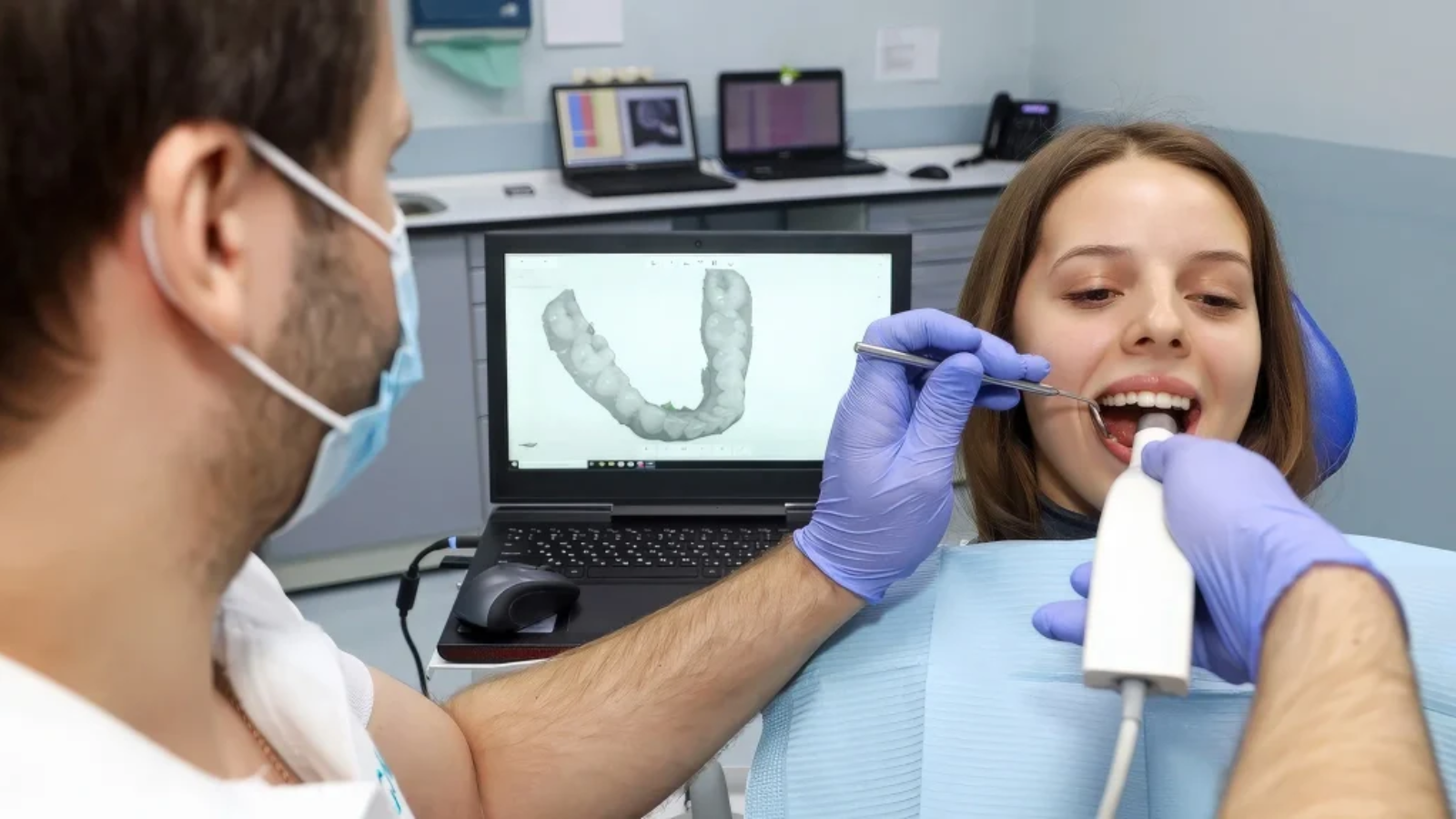
Modern dentistry increasingly relies on data obtained before any clinical intervention begins. According to the methodology of Professor Alexander von Breuer, visualisation should provide not a flat representation of the problem, but a complete three-dimensional model that reflects anatomy, functional load and potential risks. At DentalClinic24, 3D diagnostics are regarded as the foundation of accurate and predictable treatment.
Three-dimensional imaging makes it possible to assess structures that cannot be fully evaluated during a conventional examination. Tooth roots, bone density and the position of anatomically significant areas become available for volumetric analysis. At DentalClinic24, this information is used to develop a treatment strategy that accounts for each patient’s individual characteristics.
Digital impressions complement 3D diagnostics by ensuring precision when working with tooth shape and occlusion. Unlike traditional impressions, digital models capture the finest surface details and contact points. This is especially important when planning restorations and prosthetic constructions. At DentalClinic24, digital impressions help minimise inaccuracies already at the preparation stage.
Accurate visualisation plays a decisive role in complex clinical cases. Atypical tooth positioning, pronounced wear or previously performed treatments require detailed evaluation. At DentalClinic24, combining 3D imaging with digital models helps identify hidden overload zones and potential points of risk.
A major advantage of digital technologies is the ability to predict treatment outcomes. Modelling allows clinicians to assess in advance how load distribution will change after treatment and how tissues are likely to adapt. Professor Alexander von Breuer emphasises that outcome predictability begins with correct diagnostics rather than with the choice of treatment method.
Digital visualisation also enhances procedural safety. A precise understanding of depth and direction of intervention reduces the risk of trauma to adjacent structures. At DentalClinic24, these technologies are used as tools of clinical control rather than as auxiliary equipment.
For patients, 3D diagnostics and digital impressions provide greater transparency. Visualisation helps them understand the logic and sequence of treatment, reducing anxiety. At DentalClinic24, we observe that informed patients adapt more easily to treatment and adhere more accurately to recommendations.
It is important to note that digital technologies do not replace clinical judgement. They reinforce it by providing objective data. According to the professor’s methodology, technologies must be integrated into a coherent clinical strategy rather than applied in isolation. At DentalClinic24, this approach enables stable and long-term results.
Thus, 3D diagnostics and digital impressions are key elements of contemporary dentistry. They allow clinicians to see the problem before treatment begins and to make decisions based on precise data. At Dental Clinic24, visualisation is used as the foundation of successful and safe dental care.
Earlier, we wrote about occlusal wear facets and how specialists at DentalClinic24 use contact marks to diagnose overloads