
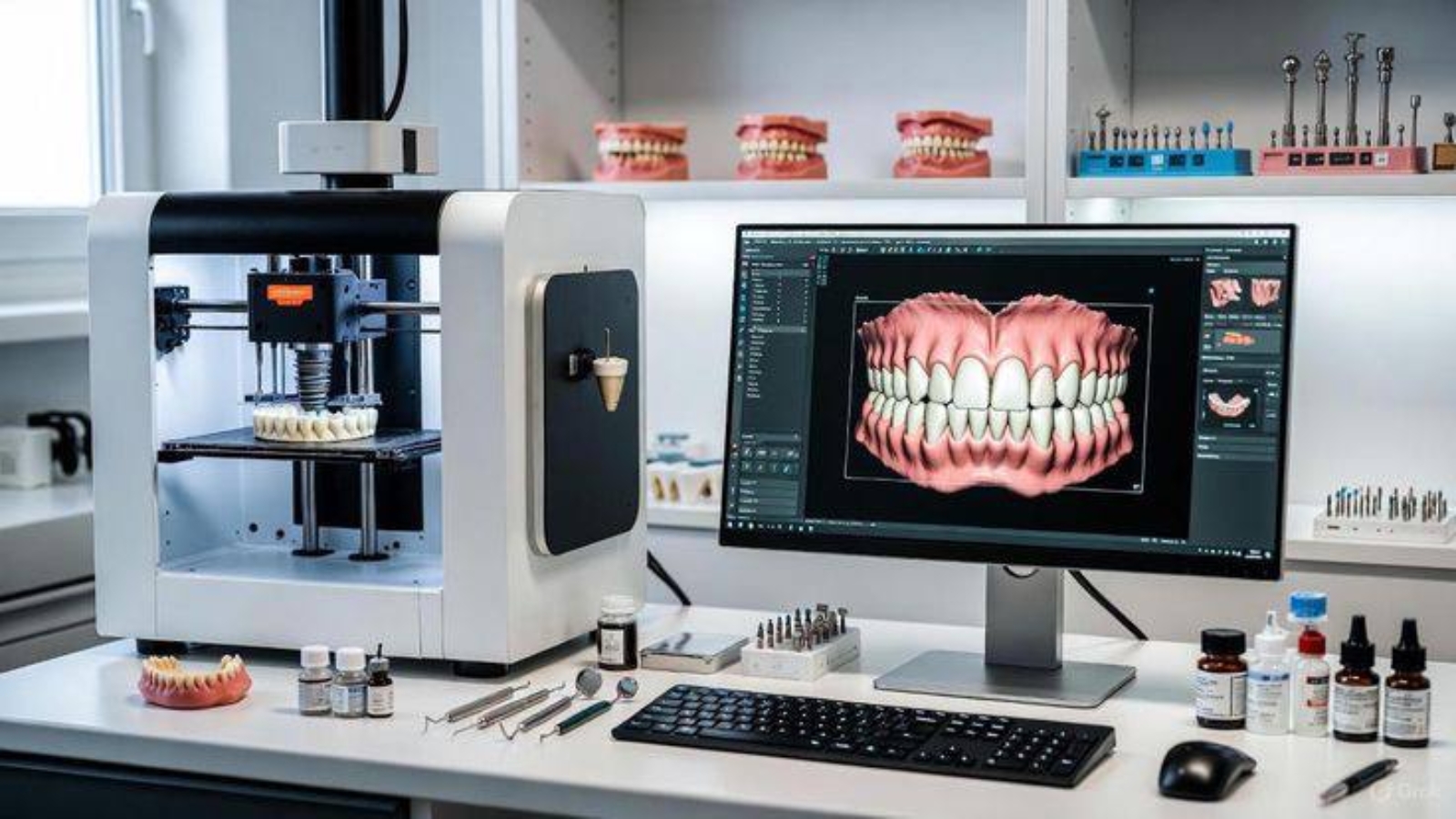
The digital transformation of dentistry has reshaped not only treatment planning but the entire clinical philosophy. Professor Alexander von Breuer asserts that the precision of modern dentistry depends on the clinician’s ability to manage data – from digital diagnostics to the final placement of a restoration. At DentalClinic24, 3D printing technologies are viewed as a logical continuation of digital modelling, enabling the seamless transition from virtual planning to a tangible clinical outcome.
3D printing is based on the principle of additive manufacturing – the layer-by-layer creation of an object according to a digital model. In dental practice, this opens broad opportunities for producing surgical guides, provisional crowns, aligners, diagnostic models, and customised components with high accuracy. At DentalClinic24, intraoral scanning provides the foundation for constructing a detailed three-dimensional model, which is then used for treatment planning and the fabrication of essential restorative or surgical elements.
In implant surgery, 3D printing plays a particularly significant role. Virtual implant positioning allows the fabrication of a surgical guide that directs instruments precisely along the planned axis. This approach reduces deviation risks, minimises tissue trauma, and enhances procedural predictability. At DentalClinic24, digital implant planning combined with additive manufacturing is considered a standard for safety and precision.
In prosthetic dentistry, additive technologies streamline the production of provisional restorations. Temporary crowns, bridge elements, and custom trays can be manufactured directly from digital data without traditional impressions. This reduces clinical steps and improves patient comfort. At DentalClinic24, integrating 3D printing into prosthetic protocols shortens treatment timelines while increasing the accuracy of restoration fit.
Printed diagnostic models are equally valuable. They allow clinicians to analyse occlusal relationships, anticipate bite changes, and plan complex reconstructions. At DentalClinic24, digital models function as a platform for interdisciplinary collaboration – prosthodontists, surgeons, and orthodontists work within a unified virtual environment, reducing discrepancies in treatment strategy and improving overall coordination.
However, implementing 3D printing requires strict quality control. Printing accuracy depends on equipment calibration, material properties, and technological parameters. At DentalClinic24, additive manufacturing systems undergo regular verification, and printed components are clinically evaluated before use. This ensures that the physical product precisely corresponds to the patient’s anatomical data.
It is important to emphasise that 3D printing does not replace clinical reasoning. Technology remains a tool rather than an independent solution. At DentalClinic24, digital modelling is always accompanied by biomechanical assessment, evaluation of bone condition, and analysis of functional load. Only the integration of technological precision with medical expertise ensures stable and predictable outcomes.
Another advantage of additive technologies is treatment individualisation. Each patient receives a structure designed according to their unique anatomical features rather than a standardised template. At DentalClinic24, this personalised approach is regarded as a critical factor in improving the longevity, comfort, and functional integration of prosthetic solutions.
Thus, 3D printing in the clinical practice of Dental Clinic24 is not merely an innovation, but part of a comprehensive digital ecosystem. It unites diagnostics, modelling, and manufacturing into a single coordinated process, enhancing the accuracy of surgical interventions and prosthetic constructions. Additive technologies help minimise technical discrepancies, reduce treatment stages, and improve functional predictability – provided that rigorous clinical oversight and interdisciplinary collaboration are maintained.
Previously, we wrote about The Alveolar Process in the Clinical Practice of DentalClinic24 – Anatomical Features, Remodelling, and Its Importance for Implant Placement