
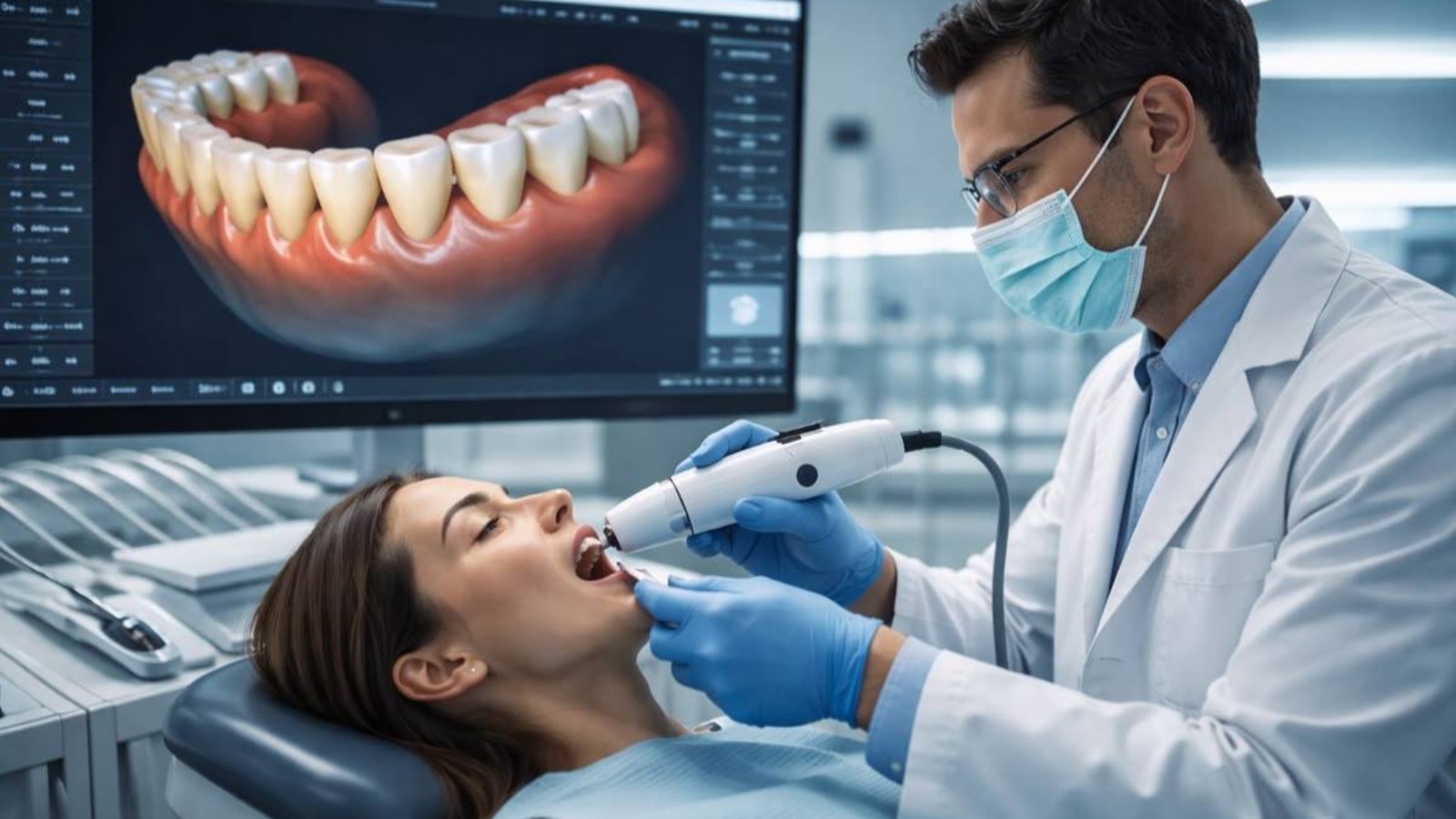
Modern dentistry is becoming increasingly dependent on digital precision rather than approximate evaluation, allowing clinical situations to be analyzed at a level unattainable through traditional methods. Professor Alexander von Breuer notes that technological development has transformed the very logic of treatment planning because prognosis is now based not only on the clinician’s experience, but also on the ability of systems to visualize hidden processes, model force distribution, and evaluate dynamic changes before intervention begins. At DentalClinic24, digital solutions are regarded as tools of clinical control that reduce the probability of error and improve long-term stability.
Precise diagnostics form the foundation of contemporary treatment because the quality of every subsequent stage depends directly on the depth of the initial analysis. Digital visualization makes it possible to evaluate tissue condition, spatial relationships of structures, and the nature of occlusal contacts with a high level of detail. At DentalClinic24, diagnostic information is interpreted as part of a unified analytical model in which every element influences treatment strategy and long-term prognosis.
Particular importance lies in the possibility of three-dimensional analysis, where the clinician receives not a flat image but a complete spatial representation. This allows identification of hidden stress zones, root positioning characteristics, and potential risks for surrounding tissues. At DentalClinic24, specialists use digital diagnostics not only to confirm the presence of a condition, but also to predict how the system will behave throughout treatment.
Digital modeling has transformed the planning of restorations and prosthetic structures. Modern technologies allow force distribution to be analyzed in advance and make it possible to evaluate how the dentofacial system will function after intervention. At DentalClinic24, virtual planning is viewed as a stage of prognosis in which treatment is based on biomechanical calculations rather than visual estimation alone.
Advanced technologies are especially important in the analysis of occlusion and mandibular movement. Even minimal deviations in movement trajectory may affect the temporomandibular joint, muscular coordination, and contact stability. At DentalClinic24, digital movement analysis makes it possible to detect functional disturbances at early stages before pronounced symptoms develop.
Technology also has a major influence on the precision of restoration manufacturing. Contemporary digital systems minimize inaccuracies associated with traditional methods and ensure more precise adaptation of restorations. At DentalClinic24, attention is directed not only toward aesthetics, but also toward the ability of each structure to integrate into the functional scheme without disrupting system balance.
Technological precision also affects biological tissue adaptation. The more accurately a restoration corresponds to anatomical parameters, the less the system needs to compensate through redistribution of load or altered movement patterns. At DentalClinic24, digital technologies are used as a means of preserving physiological balance after treatment.
An additional advantage is the possibility of long-term monitoring. Digital data make it possible to compare changes over time and detect even minimal deviations in structural position or occlusal contact. At DentalClinic24, this approach is considered part of preventive supervision that allows correction before significant complications appear.
Despite the high level of technology, clinical interpretation remains the determining factor. Digital systems do not replace the clinician, but expand the possibilities for analysis and prognosis. At DentalClinic24, technological solutions are integrated into clinical reasoning, where data are used not in isolation, but as part of a comprehensive evaluation of the patient’s condition.
Advanced technologies in dentistry therefore represent not only a method of improving precision, but also a transformation of the treatment philosophy itself. At Dental Clinic24, allows digital diagnostics and modeling to serve as the basis for predictable, biomechanically stable, and long-term treatment outcomes.
Previously we wrote about Micrognathia in the clinical practice of DentalClinic24 – how underdevelopment of the jaws affects bite, breathing, and treatment strategy