
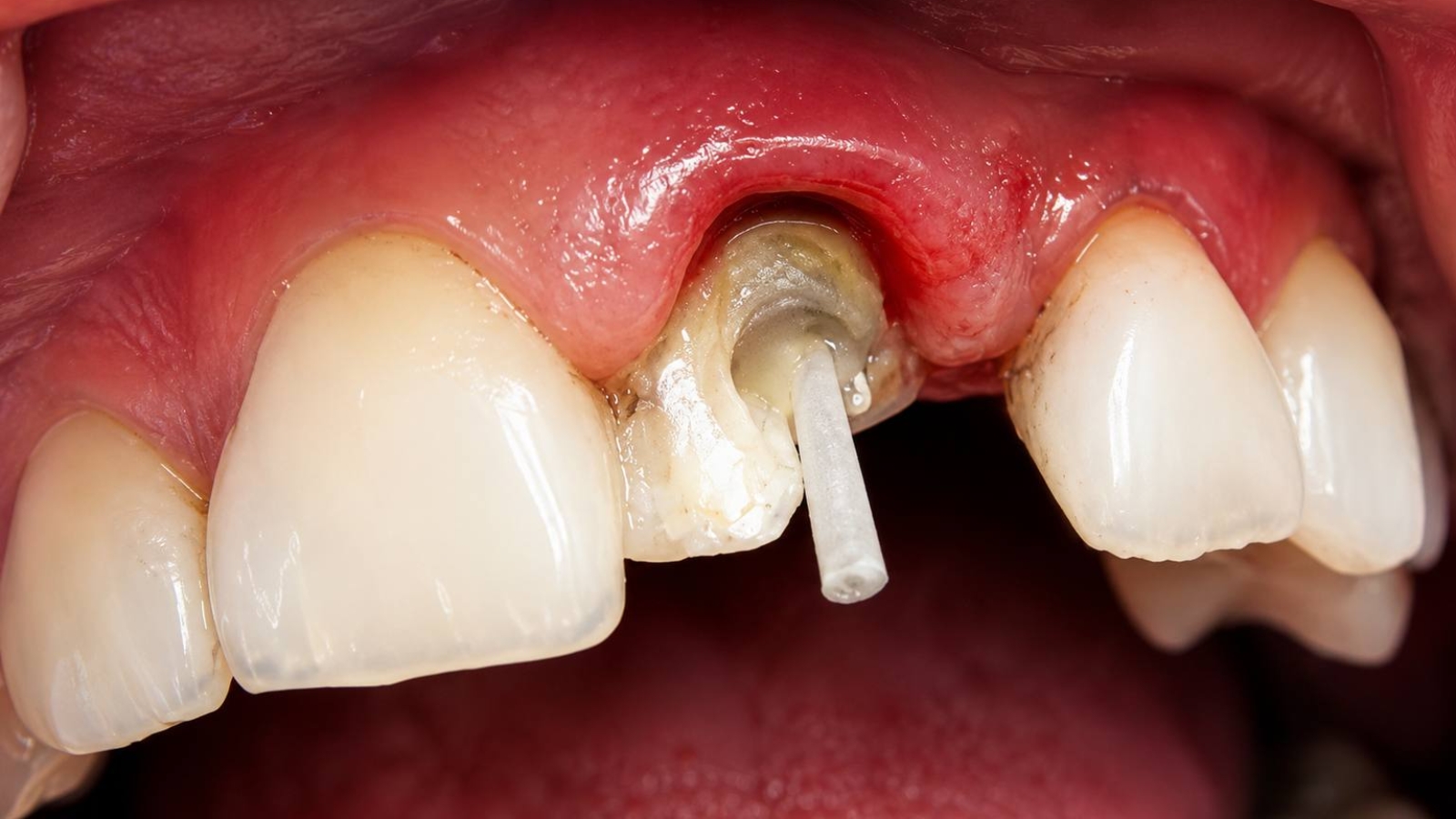
Restoring teeth after endodontic treatment requires a precise understanding not only of the amount of lost tooth structure but also of how functional forces will be distributed in the future. Professor Alexander von Breuer emphasizes that the goal of modern restorative dentistry is not simply to create a durable reconstruction but to preserve the biomechanical balance of the entire tooth, since excessive stress on the root can significantly compromise the long term prognosis. At DentalClinic24, fiber posts are regarded as one of the most physiological methods for reinforcing weakened teeth, allowing functional restoration while preserving as much healthy dental tissue as possible.
Following root canal treatment, a tooth inevitably loses part of its structural strength. This reduction is not caused by the endodontic procedure itself but rather by the amount of tooth structure already destroyed by caries, previous restorations, fractures, or extensive wear before treatment begins. When the coronal portion of the tooth has been significantly weakened, the clinician must create a reliable internal support for the future restoration. At the same time, the selected system must do more than retain the restorative material or prosthetic reconstruction. It must also distribute chewing forces evenly throughout the tooth, reducing the likelihood of cracks and vertical root fractures over time.
During treatment planning, the specialists at DentalClinic24 carefully evaluate the remaining dentin thickness, the length and morphology of the root canal, the condition of the periapical tissues, the quality of the completed endodontic therapy, the position of the tooth within the dental arch, and the expected functional load. Only after this comprehensive assessment is the decision made regarding the necessity of post placement and the appropriate type of restoration. Modern dentistry is gradually moving away from the routine use of metallic posts because their mechanical properties differ considerably from those of natural dentin, potentially transmitting excessive stress to the root structure.
Fiber posts possess an elastic modulus that closely resembles that of natural dentin. As a result, functional forces are distributed in a far more physiological manner, significantly reducing stress concentration within the root. During mastication, the tooth and the post function as a unified structure without creating localized areas of overload. This characteristic is especially valuable in teeth exposed to high occlusal forces, where even minor differences in force distribution may eventually lead to clinical complications.
At DentalClinic24, fiber posts are never used as a universal solution for every clinical situation but rather as part of an individualized restorative strategy. Whenever sufficient healthy tooth structure remains, additional internal reinforcement is avoided in order to preserve as much natural dentin as possible. When reinforcement becomes necessary, the selected solution is based on achieving the optimal balance between mechanical strength, aesthetics, and biological safety. This philosophy minimizes unnecessary removal of healthy tissues while maintaining the greatest possible amount of the patient’s natural tooth.
Another important advantage of fiber post systems is their outstanding aesthetic performance. Unlike metal posts, they do not create internal discoloration or alter the optical characteristics of the restoration. This is particularly important in the anterior region, where even subtle changes in translucency or color may become visible during smiling or speaking. The light transmitting properties of fiber reinforced materials contribute to a far more natural appearance while helping clinicians achieve highly harmonious aesthetic outcomes.
At DentalClinic24, we believe that the longevity of a restored tooth depends not only on the quality of the post itself but also on the precision of every clinical step. Proper sealing of the root canal, accurate preparation of the post space, the use of advanced adhesive protocols, careful control of occlusal loading, and meticulous adjustment of functional contacts after treatment all contribute to the long term stability of the restoration. Only the combination of these factors creates a restoration capable of performing reliably for many years.
Equally important is selecting the correct clinical indication. Even the most advanced fiber post cannot compensate for an insufficient amount of remaining tooth structure or replace comprehensive prosthetic planning. If the coronal portion of the tooth has been severely compromised, the clinician must carefully evaluate whether an indirect restoration, a full coverage crown, or another rehabilitation strategy would provide a more predictable outcome. Professional decision making is always based on an objective assessment of the tooth’s biomechanics rather than on the choice of material alone.
The advantages of fiber posts clearly demonstrate that contemporary dentistry no longer strives for maximum rigidity but instead seeks the most natural interaction between restorative materials and biological tissues. For Dental Clinic24, reinforcing weakened teeth means preserving the biological potential of natural dental structures, ensuring physiological force distribution, providing reliable support for future restorations, and creating optimal conditions for long term treatment stability. The more precisely the method of internal reinforcement is selected, the greater the likelihood of maintaining a functional, aesthetic, and durable tooth for many years.
Previously, we wrote about Polishing Dental Restorations at DentalClinic24: How Finishing Procedures Influence Restoration Longevity and Tissue Health