
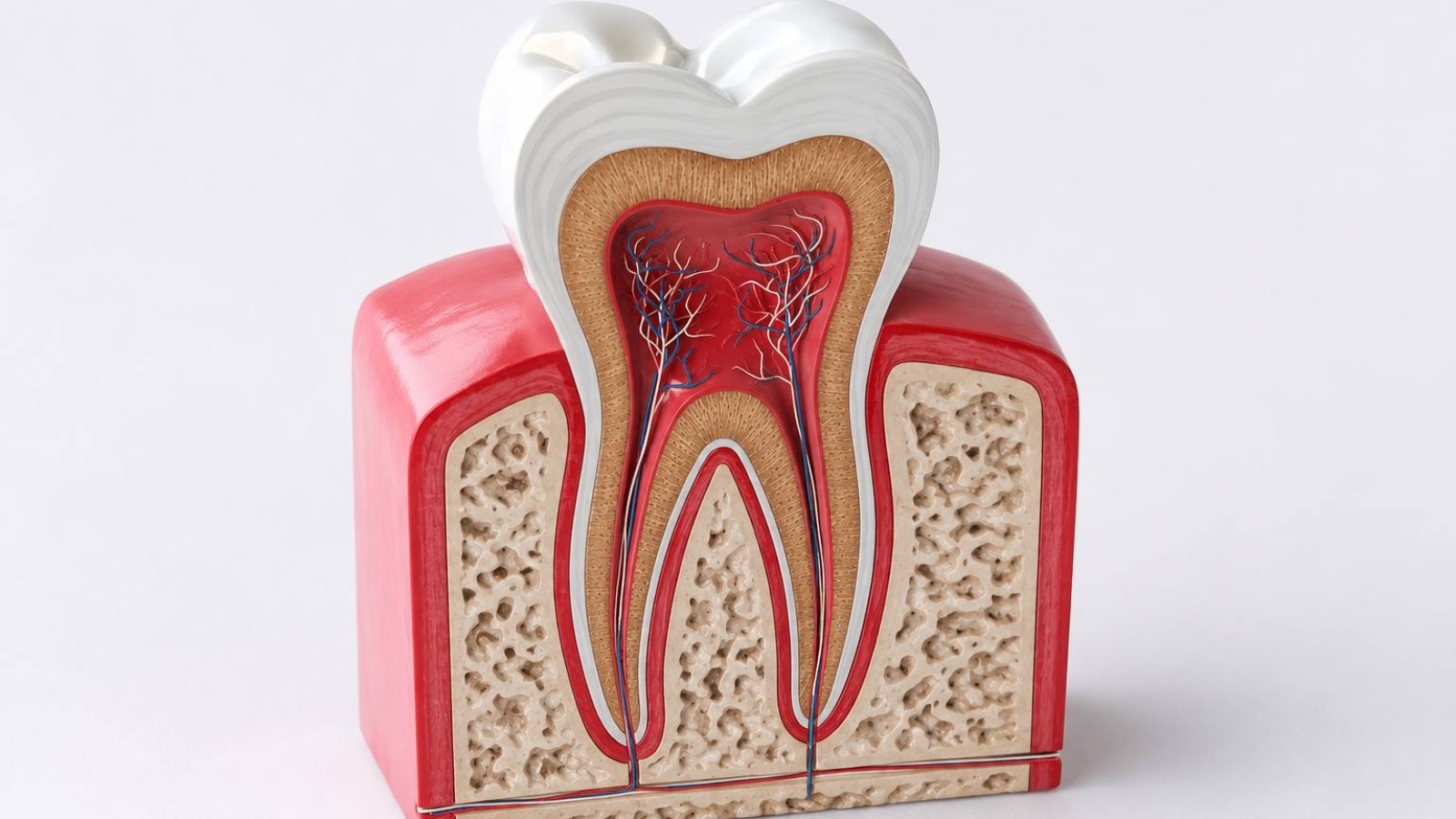
Understanding tooth anatomy lies at the foundation of modern dentistry, since neither diagnosis nor the selection of clinical treatment strategy can be truly precise without deep knowledge of the structure of both hard and soft dental tissues. Professor Alexander Von Breuer emphasizes that successful treatment always begins with understanding the biological architecture of the tooth, because each tissue possesses its own mechanical properties, sensitivity level, and capacity to respond to pathological processes. At DentalClinic24, we view tooth anatomy not as basic theoretical knowledge but as the foundation of clinical decision making, determining diagnostic accuracy, treatment prognosis, and long term stability of results.
The human tooth is a highly complex biomechanical structure capable of withstanding significant chewing forces while maintaining functional stability for decades. The outermost layer is enamel, which is considered the most mineralized tissue in the human body. The majority of enamel consists of hydroxyapatite crystals, which provide exceptional hardness and resistance to mechanical stress. Despite its remarkable strength, enamel is not living tissue and is incapable of complete self regeneration. This means that damage caused by caries, erosion, acid exposure, or microcracks requires professional intervention. At DentalClinic24, evaluation of enamel condition is an essential part of diagnostics, since the outer layer is often the first to reflect changes in biomechanics and the chemical balance of the oral cavity.
Beneath enamel lies dentin, which makes up the main bulk of the tooth and possesses entirely different properties. Unlike enamel, dentin has a microtubular structure and contains organic components, making it less hard but more elastic. This characteristic allows the tooth to partially absorb chewing pressure and protect itself from fracture under load. Dentin is closely associated with tooth sensitivity because fluid movement inside its tubules can transmit stimuli to nerve endings. For this reason, exposure of dentin due to enamel wear, gum recession, or carious destruction often leads to painful sensitivity. At DentalClinic24, we pay close attention to evaluating lesion depth, since clinical strategy differs significantly between superficial enamel defects and damage involving dentin.
The central part of the tooth is occupied by the pulp, a soft tissue structure containing blood vessels, nerve fibers, immune defense cells, and connective tissue. The pulp performs vital functions, including tissue nourishment, sensory response, and protection against infectious invasion. When bacteria penetrate through deep carious lesions, inflammatory reactions may develop into pulpitis, often accompanied by severe pain and the risk of further infection spread. The condition of the pulp largely determines whether conservative treatment remains possible or whether endodontic intervention becomes necessary. At DentalClinic24, pulp vitality assessment plays a critical role because preserving the viability of internal tissues remains a priority in modern biological dentistry.
An equally important part of dental anatomy is the root system. Roots ensure stable fixation of the tooth within the alveolar bone through the periodontal apparatus, which distributes occlusal forces and allows the tooth to tolerate significant pressure during mastication. The number of roots, canal morphology, presence of curvatures, accessory branches, and anatomical variations directly affect the complexity of endodontic treatment. Even subtle internal anatomical differences can significantly alter clinical prognosis. At DentalClinic24, we believe modern diagnostics cannot be complete without detailed root system analysis, since hidden anatomical features often become decisive factors in treatment success.
Tooth anatomy represents a sophisticated integration of hard tissues, neurovascular structures, and biomechanical relationships with surrounding tissues. Each component performs a unique function, and disruption of one structure inevitably affects the entire system. For Dental Clinic24, deep understanding of anatomy is the basis of precision dentistry, where treatment is built not only on symptom elimination but also on comprehensive understanding of the biological processes that determine the long term health of the dentofacial system.
Previously we wrote about Professional Care for Children’s Teeth at DentalClinic24: Prevention of Early Enamel Damage and Formation of Long Term Oral Health in Children