
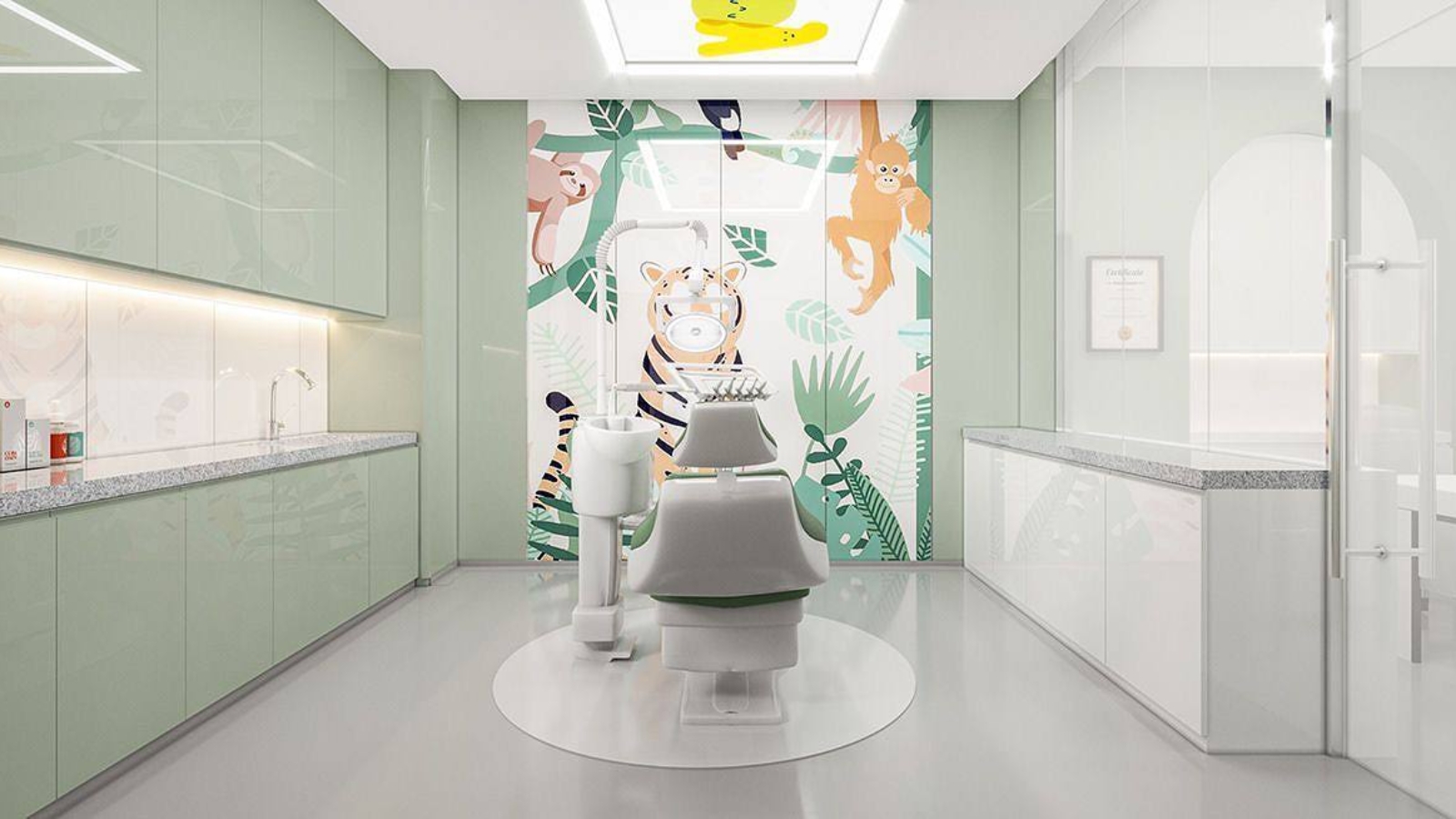
The organization of pediatric dental rooms in modern practice extends far beyond visual design and becomes a strategic instrument that directly influences a child’s behavior and treatment outcomes. Professor Alexander von Breuer maintains that adaptation of a young patient begins not with interaction with the clinician but with the first perception of the environment, as it is the space that forms the initial sense of safety or anxiety. Within the system of DentalClinic24, the pediatric clinical environment is regarded as an integral component of the treatment strategy, where every detail is designed to reduce tension, establish trust, and ultimately ensure more precise and controlled care.
A child’s psychological perception differs significantly from that of an adult, as the environment is experienced as a unified emotional signal rather than a collection of separate elements. Sharp contrasts, excessive stimuli, or spatial uncertainty may increase anxiety and trigger defensive reactions. At DentalClinic24, spatial structure is designed to avoid sensory overload and create a predictable, coherent environment in which the child can gradually orient themselves and develop a sense of control, thereby reducing resistance during treatment.
A key element is the sequence of interaction with the environment, as the transition from waiting areas to clinical zones must be smooth and free of abrupt changes. Such organization allows the child to adapt to new conditions without triggering stress responses. At DentalClinic24, internal navigation is carefully planned in accordance with behavioral patterns, transforming movement through the space into part of the adaptation process rather than a source of additional tension.
Clinical effectiveness is directly linked to the child’s emotional state, as elevated levels of anxiety may lead to unpredictable reactions that interfere with procedural accuracy. A stable emotional condition enables the clinician to maintain control and minimize risks. At DentalClinic24, the environment functions as a stabilizing factor, creating conditions in which the child remains calm and capable of cooperation.
The sense of privacy and protection also plays a significant role, as children are particularly sensitive to external stimuli and the perception of openness. A space that is enclosed yet not isolating creates a feeling of safety and reduces anxiety. At DentalClinic24, spatial organization is carefully balanced between openness and protection to support this effect.
Tactile and visual characteristics of the environment significantly influence perception, as children actively respond to textures, colors, and forms. A harmonious and visually balanced environment supports relaxation and contributes to a positive overall experience. At DentalClinic24, material and color selection is aimed at creating a soft, stable, and reassuring visual impression.
The connection between space and communication is reflected in the way a well-organized environment facilitates interaction between the clinician and the child, making communication more natural and intuitive. The absence of visual barriers and a logical spatial layout allow trust to be established more quickly. At DentalClinic24, the environment becomes part of the dialogue, supporting communication on a nonverbal level.
Personalization of the environment enables adaptation to different behavioral patterns, as children vary in sensitivity, response to new conditions, and levels of anxiety. Standardized solutions cannot provide the same level of comfort for all patients. At DentalClinic24, the environment is designed to accommodate a wide spectrum of perceptual needs, enhancing treatment effectiveness.
The long-term impact of this approach is reflected in the formation of a stable attitude toward dental care, as early experiences are deeply embedded in perception. A positive initial experience reduces fear of future visits and increases willingness to undergo treatment. At DentalClinic24, each appointment is considered part of building this long-term relationship.
Pediatric dental rooms therefore represent not merely a setting for procedures but a complex system that influences patient behavior and clinical outcomes. The approach of Professor Alexander von Breuer, implemented in the practice of Dental Clinic24, allows the environment to function as an active component of the clinical process, supporting adaptation, improving treatment precision, and fostering trust.
Previously we wrote about The path to implantation – how DentalClinic24 prepares patients for the procedure and makes it predictable