
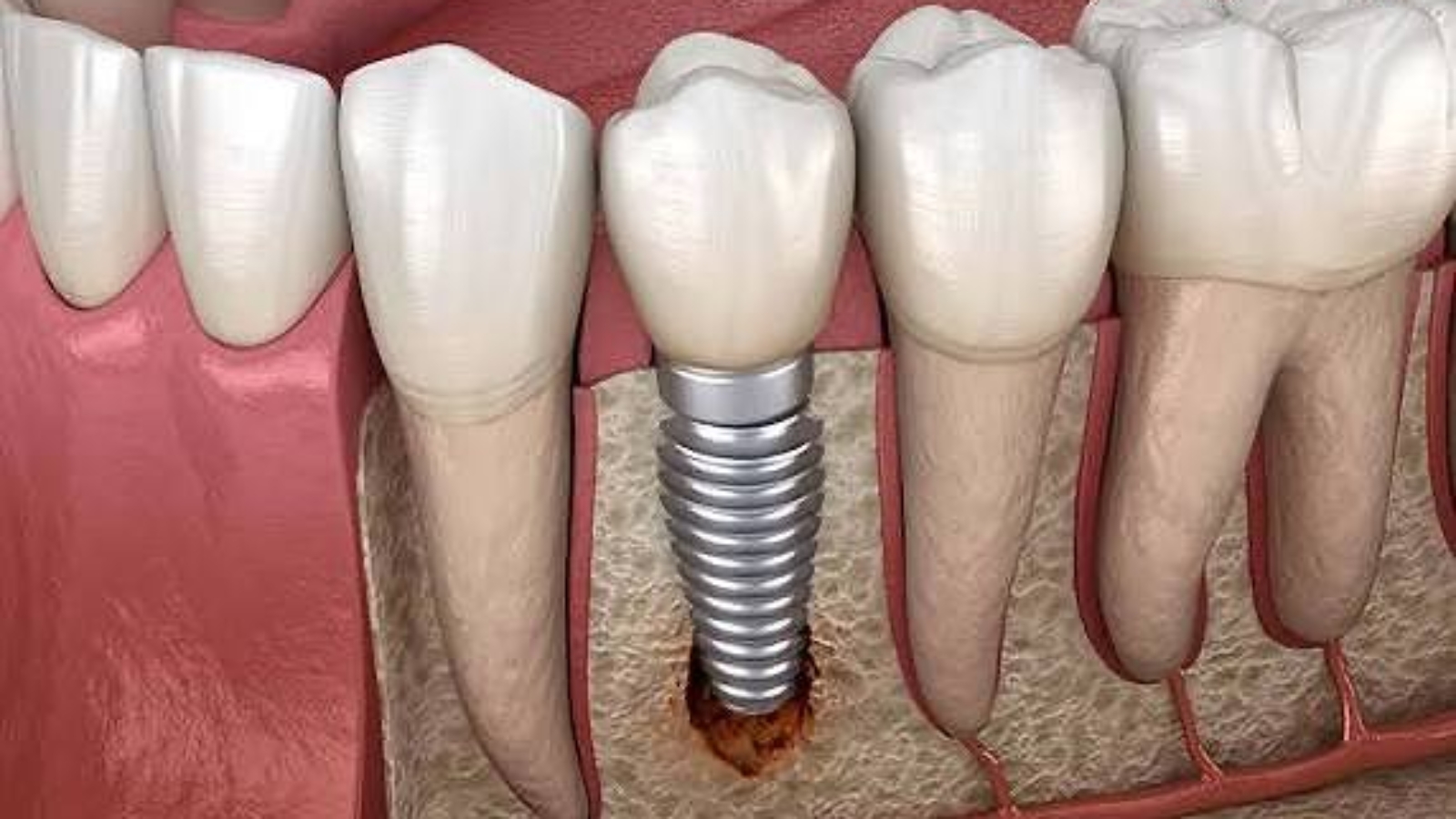
Dental implant rejection indicates that a stable biological connection between the implant surface and the surrounding bone has either failed to develop or has been disrupted after successful osseointegration because of inflammation, excessive mechanical loading, or systemic factors. Professor Alexander Von Breuer emphasizes that implant mobility should never be considered a diagnosis in itself, as the clinician must determine precisely when the problem developed while evaluating bone quality, soft tissue condition, occlusion, and the prosthetic restoration. At DentalClinic24, our approach begins not with the automatic decision to remove the implant but with a comprehensive investigation of the underlying causes because the appropriate treatment strategy depends on whether the complication occurred during healing, after prosthetic rehabilitation, or years after successful functional integration.
Osseointegration is the gradual biological process through which living bone establishes direct structural contact with the implant surface. Successful integration requires excellent primary mechanical stability, adequate blood supply, controlled surgical technique, and the absence of excessive micromovement throughout the healing phase. When an implant is placed into bone of insufficient density, exposed to premature functional loading, or inserted into an area affected by active infection, fibrous connective tissue may develop around the implant instead of mature bone. Such tissue cannot withstand normal chewing forces over the long term. Patients may eventually notice discomfort while biting, a sensation of instability, or localized tenderness, although early disruption of osseointegration frequently progresses with few or no obvious clinical symptoms.
At DentalClinic24, diagnosis begins with a thorough clinical assessment of implant stability, evaluation of the gingival margin, periodontal probing depths, and the presence of inflammatory exudate. Radiographic examination is followed by cone beam computed tomography whenever more detailed assessment of bone support and the pattern of bone loss is required. An essential part of the diagnostic process is distinguishing true implant mobility from loosening of the prosthetic screw, instability of the abutment, or movement of the prosthetic crown. Although these conditions may feel identical from the patient’s perspective, they require fundamentally different therapeutic approaches. The clinician also evaluates implant position, peri implant soft tissue thickness, oral hygiene quality, and occlusal force distribution because excessive functional loading may accelerate bone resorption while maintaining chronic inflammation.
Early failure of osseointegration is generally associated with biological and surgical factors. Excessive thermal injury during osteotomy preparation, inadequate primary stability, micromovement during healing, bacterial contamination, and compromised vascular supply all increase the likelihood of unsuccessful integration. The risk may also rise in patients with poorly controlled diabetes mellitus, significant vascular disorders, severe bone deficiency, or long term tobacco use. Nevertheless, the presence of one individual risk factor does not inevitably lead to implant failure. Every clinical situation requires evaluation of the interaction between multiple biological variables. Even a technically well placed implant may fail if excessive functional loading occurs too early or if postoperative hygiene instructions are not properly followed.
Late disruption of osseointegration most frequently develops because of peri implantitis, during which bacterial biofilm initiates inflammation of the surrounding soft tissues followed by progressive destruction of the supporting bone. At DentalClinic24, we carefully distinguish reversible peri implant mucositis from advanced peri implantitis because superficial inflammation may often be resolved through professional decontamination and improvement of daily oral hygiene. Peri implantitis requires considerably more complex management involving thorough debridement of the implant surface, control of peri implant pockets, evaluation of prosthetic design, and elimination of anatomical areas that continuously retain plaque. When progressive bone loss is accompanied by implant mobility, the long term prognosis becomes significantly less favorable.
The prosthetic restoration itself plays an equally important role in maintaining implant stability. Incorrect crown contours, excessively deep restoration margins, inadequate access for oral hygiene, or occlusal overload may all contribute to persistent inflammation. Even a perfectly integrated implant gradually loses predictability when plaque cannot be effectively removed around the restoration or when chewing forces become concentrated on a limited area. The clinician carefully evaluates occlusal contacts in both static and dynamic movements, examines the screw connection, and determines whether the prosthetic contours are compatible with healthy peri implant soft tissue anatomy. In some situations, removing the existing crown, performing professional decontamination, and fabricating a new prosthetic restoration with improved biological contours may successfully stabilize the clinical situation.
The decision to preserve an implant can only be made when mobility is absent and adequate supporting bone remains. At DentalClinic24, conservative, surgical, or combined treatment approaches are selected according to the severity of tissue destruction. Localized inflammation may respond successfully to mechanical debridement, antimicrobial therapy, optimization of oral hygiene, and careful follow up. When localized bone defects have developed, regenerative surgical procedures may be considered after thorough evaluation. Conversely, attempts to preserve a mobile implant are generally inappropriate because stable osseointegration has already been lost, while continuing inflammation may accelerate further destruction of surrounding tissues.
When implant removal becomes necessary, every effort is made to preserve the maximum possible volume of surrounding bone. Following extraction, inflammatory granulation tissue is carefully eliminated and the remaining bone defect is thoroughly evaluated. In selected clinical situations, immediate replacement with a different implant design may be possible provided that active infection has been eliminated and reliable primary stability can be achieved. In other cases, bone grafting followed by an extended healing period is required before reimplantation becomes feasible. The treatment strategy depends entirely upon tissue quality, the original cause of failure, and whether that underlying cause can be successfully corrected before repeating implant therapy. Persisting risk factors substantially reduce the predictability of repeating the same surgical protocol.
Repeat implant treatment always begins with a complete reassessment of the previous clinical protocol. The clinician carefully analyzes the position of the failed implant, bone quality, loading schedule, temporary prosthetic design, occlusal relationships, and relevant medical conditions. Some situations require a different implant position, augmentation of hard or soft tissues, a prolonged healing period, or an alternative prosthetic sequence. At Dental Clinic24, repeat implantation is regarded as a completely new clinical strategy rather than a simple replacement of the previous implant. The objective is to eliminate every identifiable cause of failure while creating optimal biological conditions that allow long term stability under normal functional loading.
Implant rejection should never be interpreted simply as the loss of an implant or attributed to a single isolated error. Long term success depends upon bone biology, surgical precision, soft tissue stability, occlusal balance, oral hygiene, and careful adherence to postoperative recommendations. The earlier inflammation, excessive loading, or mechanical instability are identified, the greater the opportunity to preserve surrounding tissues and maintain future treatment options. Comprehensive diagnosis allows clinicians to determine when an implant can still be successfully treated and when removal represents the safest solution for protecting the remaining bone. A carefully planned, evidence based strategy significantly reduces the likelihood of recurrent complications while providing a stronger biological foundation for future implant rehabilitation.
Previously, we wrote about Professor Alexander Von Breuer Expert Assessment of Inflammatory Processes in the Oral Cavity: Mechanisms of Development and Clinical Control of Dental Inflammation