
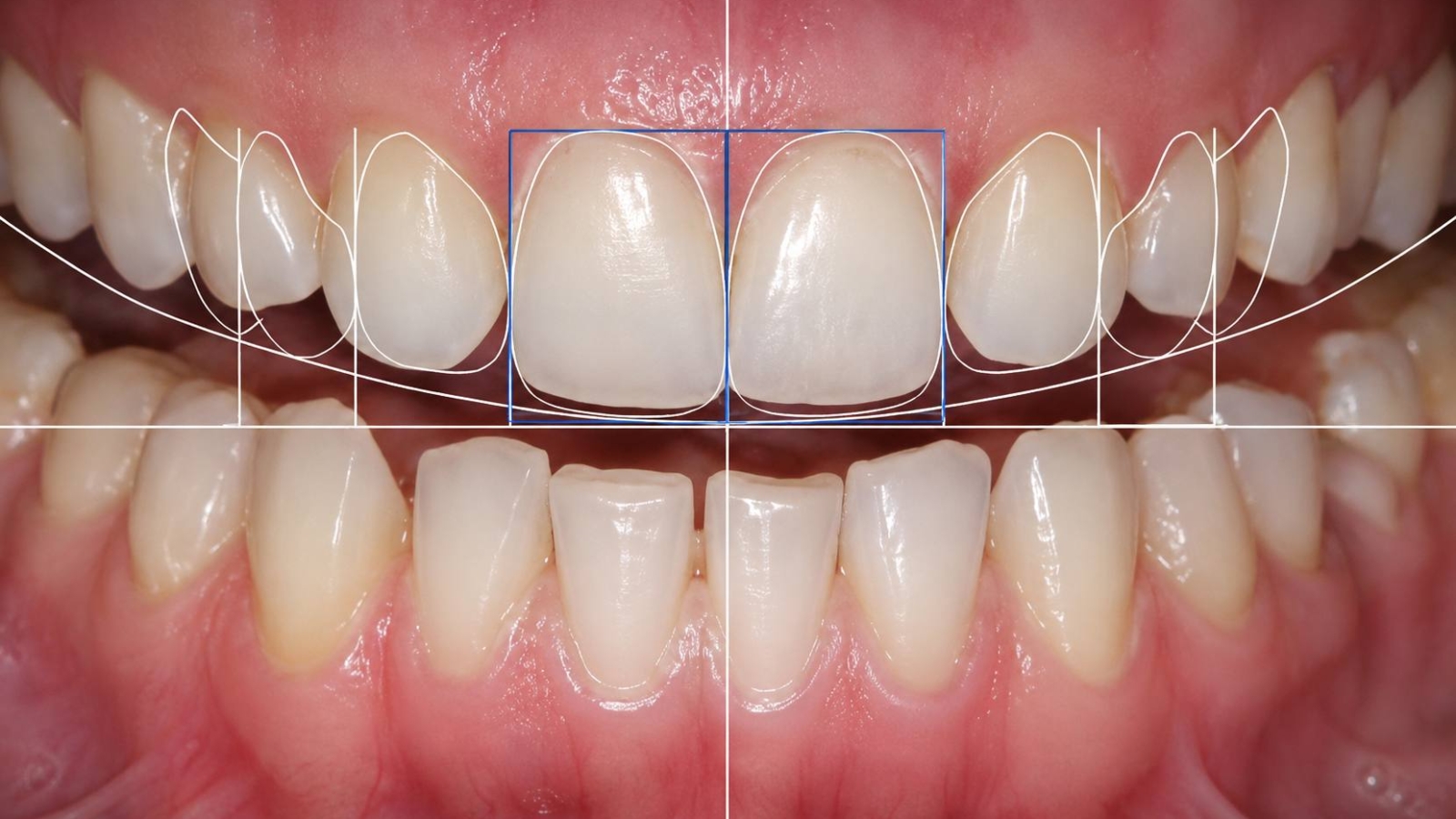
A future smile should never be based on assumptions or verbal promises. It should be a carefully calculated clinical project that can be evaluated before any irreversible dental treatment begins. Professor Alexander Von Breuer emphasizes that high quality aesthetic dentistry starts with a precise understanding of the final outcome because the shape of the crowns, the position of the incisal edges, the visibility of the teeth during speech, and the relationship between the smile and the patient’s facial features must all be determined before tooth preparation or restoration placement. At DentalClinic24, we use Digital Smile Design as both a diagnostic and communication tool that combines clinical photography, intraoral scanning, occlusal analysis, and the patient’s individual facial dynamics. This approach allows us not simply to present an attractive image but to create a realistic treatment plan based on anatomy, function, and the preservation of healthy dental tissues.
Aesthetic evaluation extends far beyond selecting the width of the central incisors or choosing a brighter shade. The clinician analyzes facial symmetry, the interpupillary line, lip contours, tooth display at rest, smile dynamics, gingival architecture, and the proportions of every tooth within the dental arch. The same design may appear harmonious in a static photograph while looking entirely different during conversation or natural facial expression. For this reason, digital planning requires a series of photographs and video recordings that reveal lip movement and changes in tooth exposure throughout facial function. The position of the incisal edges is particularly important because even minimal changes in tooth length may influence speech, occlusion, and mandibular movement. These parameters cannot be determined solely by aesthetic templates or mathematical formulas.
At DentalClinic24, every digital treatment plan is created using real clinical data. An intraoral scanner generates a highly accurate three dimensional model of the dentition that precisely records tooth anatomy, interdental contacts, available restorative space, and occlusal relationships. Facial photographs are then integrated with the digital models, allowing the clinician to determine the ideal width, length, and position of future restorations. When veneers, crowns, or multiple restorations are planned simultaneously, we evaluate in advance whether enamel preparation will be necessary and to what extent. If an individual tooth is significantly protruded, inclined, or malpositioned, simply increasing its external dimensions may disrupt facial harmony. Digital analysis identifies these limitations before treatment begins and allows us to select the most biologically appropriate corrective strategy.
Visualizing the anticipated outcome is particularly valuable when patients wish to improve their smile but cannot clearly describe the appearance they hope to achieve. Expressions such as natural, balanced, or more expressive are highly subjective and provide limited clinical guidance. Digital Smile Design transforms these expectations into measurable treatment parameters. Different incisal lengths, contour variations, transitional angles, and levels of enamel translucency can all be evaluated while simultaneously assessing their influence on lip support and overall facial harmony. Patients are not shown isolated white teeth on a computer screen but rather their own future smile integrated naturally into their facial appearance. This significantly reduces the likelihood of discrepancies between expectations and the final clinical result.
At DentalClinic24, the digital design can also be transferred directly into the patient’s mouth through the fabrication of a diagnostic mock up. Based on the virtual project, a temporary prototype is created and positioned over the existing teeth without irreversible preparation. This allows patients to observe the proposed proportions in the mirror, evaluate their smile during conversation, and experience changes in tooth length before definitive treatment begins. For the clinician, this stage provides much more than aesthetic confirmation. We evaluate phonetics, soft tissue support, occlusal comfort, and accessibility for oral hygiene. Whenever adjustments become necessary, modifications are performed directly on the prototype before being transferred back into the digital model. As a result, the definitive restorations are fabricated from a clinically verified design rather than a purely theoretical concept.
Digital Smile Design also establishes the biological limits of treatment before any irreversible procedures are performed. If the desired outcome requires substantial changes in tooth position, orthodontic correction may be recommended instead of excessive enamel reduction. When clinical crowns appear too short, periodontal contour modification may become part of the treatment plan. In cases involving severe tooth wear, digital analysis helps identify the underlying causes while assisting in the restoration of the correct vertical dimension of occlusion. Sometimes the virtual simulation demonstrates that conservative treatment involving only two or four teeth will provide a more natural result than comprehensive rehabilitation of the entire anterior segment. Such planning protects healthy dental tissues while preventing unnecessary treatment.
Functional assessment remains an essential component of every aesthetic project. Altering tooth morphology inevitably changes occlusal contacts and influences mandibular movement. If incisal edges are lengthened without proper occlusal analysis, they may be subjected to excessive localized forces, increasing the risk of chipping, fractures, and mechanical overload of restorations. In patients affected by bruxism, pathological tooth wear, or unstable occlusion, aesthetic rehabilitation must be incorporated into a broader functional treatment strategy. Digital models enable detailed comparison of the upper and lower arches, evaluation of available restorative space, and identification of areas requiring occlusal refinement. This ensures that the planned result is not only visually harmonious but also mechanically predictable.
At DentalClinic24, digital treatment planning also serves as the foundation for close collaboration between the restorative dentist, dental technician, and other specialists involved in treatment. Instead of receiving only conventional impressions or shade instructions, the laboratory works from a complete digital project that includes facial photographs, predetermined tooth proportions, and a clinically validated mock up. The technician clearly understands the acceptable ceramic thickness, areas where translucency should be preserved, the exact restoration contours, and the final position of the incisal edges. When treatment also includes implant placement, orthodontics, or periodontal procedures, every phase is coordinated according to one comprehensive digital blueprint. This integrated workflow minimizes technical compromises while significantly improving treatment predictability.
The precision of digital planning does not mean that clinical decisions are delegated entirely to computer software. Digital technology provides valuable reference points, but every final decision is made after considering tissue biology, enamel quality, root position, periodontal condition, and each patient’s unique anatomical characteristics. Perfect digital symmetry should never produce an artificial appearance. Minor anatomical differences between teeth, natural surface texture, and individual enamel translucency contribute to the authenticity of a healthy smile. Our objective is not to standardize every patient but to develop proportions that complement facial features while preserving natural individuality.
We regard Digital Smile Design as a method of making aesthetic dentistry predictable before treatment becomes irreversible. Preliminary visualization, three dimensional planning, clinical mock ups, and functional verification enable us to align patient expectations, minimize unnecessary enamel preparation, and improve the precision of definitive restorations. At Dental Clinic24, every future smile is developed through comprehensive analysis of facial proportions, dental anatomy, occlusion, and soft tissue characteristics rather than by following standardized templates. This systematic approach allows patients to visualize the direction of treatment in advance while enabling clinicians to create smiles that remain natural, functional, and stable for many years.
Previously, we wrote about How DentalClinic24 Predicts the Risk of Tooth Destruction Before Symptoms Appear