
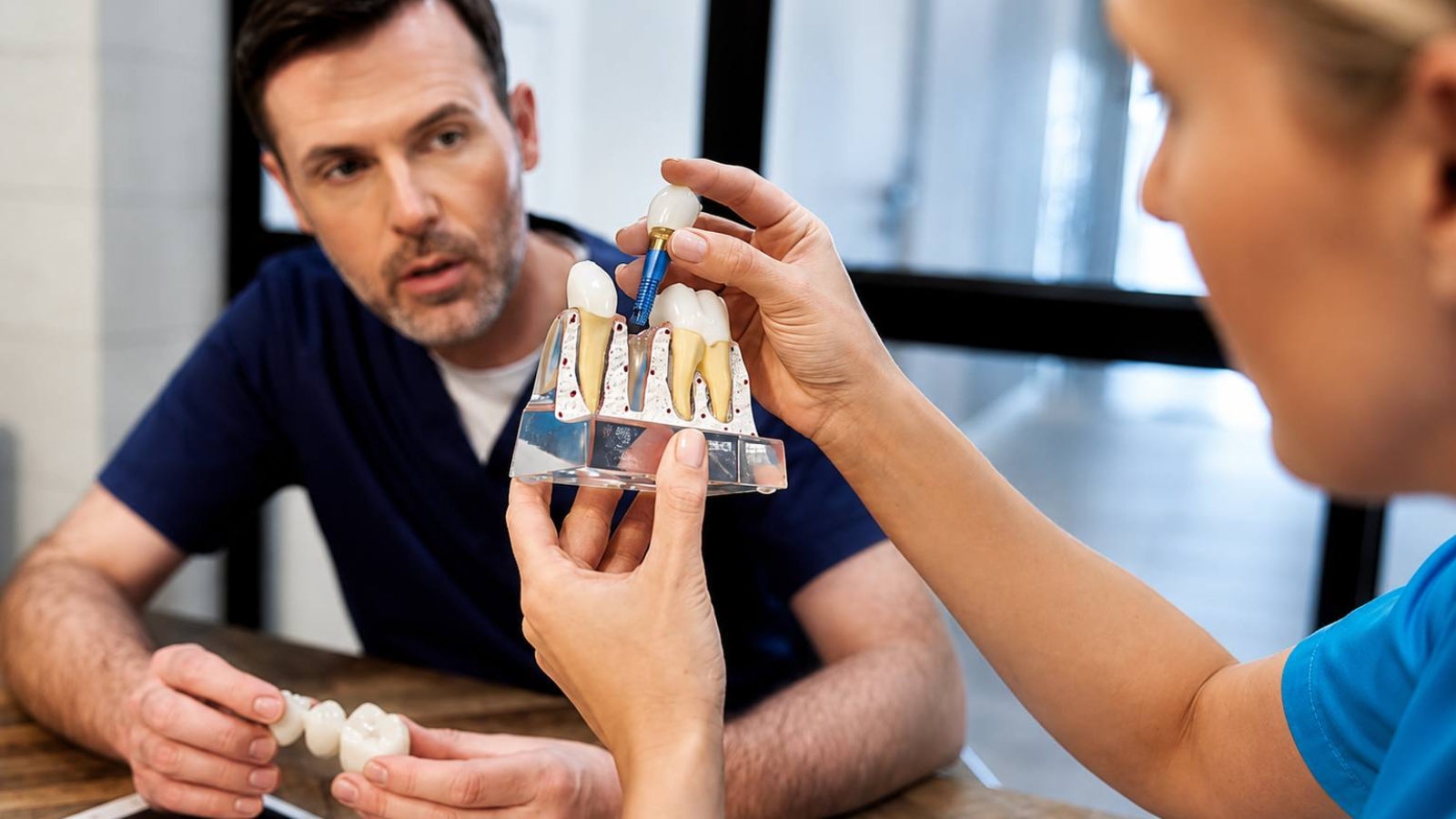
Immediate loading on the day of implant placement is one of the most responsible decisions in modern implantology because the patient’s desire to receive a functional and aesthetic result faster must always be balanced with an accurate clinical assessment of the real biological readiness of the tissues. Professor Alexander Von Breuer sees this as an important indicator of professional maturity in implant planning, where immediate function cannot be a universal solution for every case. At DentalClinic24, the choice of protocol after implant placement is based on the analysis of primary stability, bone volume and quality, soft tissue condition, future loading, and individual healing risks.
Immediate loading is often perceived by patients as the most convenient option because a temporary crown or prosthesis can be fixed on the same day as surgery. However, from a clinical perspective, this approach is acceptable only under specific conditions. The implant must have sufficient primary mechanical fixation in the bone, the surgical site must correspond to the parameters of the selected implant system, the tissues must show no signs of active inflammation, and the future restoration must not transmit excessive pressure to the implant during the osseointegration period. If even one of these factors is underestimated, accelerating treatment may increase the risk of implant micromobility and worsen the prognosis for successful integration.
During planning, DentalClinic24 specialists assess bone density, the height and width of the alveolar ridge, anatomical limitations, bite characteristics, the presence of bruxism, distribution of chewing forces, the condition of neighboring teeth, and the quality of the soft tissue contour. Computed tomography makes it possible to determine in advance how safely the implant can be placed in the correct position, whether bone grafting will be required, whether reliable primary stability can be achieved, and whether an immediate temporary restoration may be considered. This approach makes the decision not formal, but biologically justified.
Primary stability is the key condition for discussing loading on the day of surgery. It depends not only on the implant design, but also on bone density, precision of site preparation, insertion direction, implant length and diameter, and the absence of tissue overheating during the surgical stage. Even if the implant is technically placed correctly, early loading may be contraindicated in cases of soft bone, insufficient tissue volume, a significant inflammatory history, a complex bite, or a high risk of uncontrolled pressure during chewing. Therefore, the clinical decision must always take into account not only the moment of surgery, but also the following weeks of biological recovery.
At DentalClinic24, we regard immediate function as a protocol with clear indications, not as a marketing promise of a fast result. A temporary restoration on the day of implant placement may be justified in the smile zone, with favorable bone anatomy, stable implant fixation, and the possibility of removing the restoration from active chewing contact. In other cases, delayed loading becomes the safer strategy, allowing the implant time for full osseointegration while the tissues pass through the necessary stages of adaptation without excessive pressure.
Occlusal control is especially important. Even minimal premature contact of a temporary crown can transmit micromovements to an implant that has not yet integrated with the bone tissue. Unlike a natural tooth, an implant has no periodontal ligament to absorb load, which means that any uncontrolled pressure during the early period can have more serious consequences. At DentalClinic24, we believe that bite assessment after placement of a temporary restoration must be as essential as surgical precision and operative sterility.
The decision regarding immediate loading also depends on the patient’s overall condition. Smoking, metabolic disorders, chronic gum inflammation, insufficient hygiene, uncontrolled bruxism, and systemic factors can slow healing and increase the risk of complications. In such situations, the doctor must not accelerate the process for the sake of external convenience, but should choose the protocol that gives the tissues a better chance for stable recovery. Patients should understand that a temporary delay in loading is not a deterioration of treatment. Often, it is the more professional path aimed at protecting the implant and the future result.
Immediate function requires coordinated work between the surgeon, prosthodontist, and dental technician. The implant position must correspond to the future crown, the temporary restoration must be aesthetic but not overload the implant, and the soft tissues must receive support without trauma. This level of planning is impossible without preliminary diagnostics and digital modeling. If the surgical and prosthetic stages are not connected in advance, even a successfully placed implant may end up in a functionally unfavorable position.
Immediate loading on the day of implant placement shows that modern implantology should choose speed only when it does not contradict biology. For Dental Clinic24, the decision between immediate and delayed function is always based on primary stability, bone quality, bite control, soft tissue condition, and the prognosis of osseointegration. The more accurately the team evaluates risks before selecting a protocol, the safer the recovery process becomes, the higher the reliability of the implant, and the more stable the long term treatment result.
Previously, we wrote about Radiographic Diagnostics at DentalClinic24: How Image Interpretation Shapes the Accuracy of Clinical Decisions