
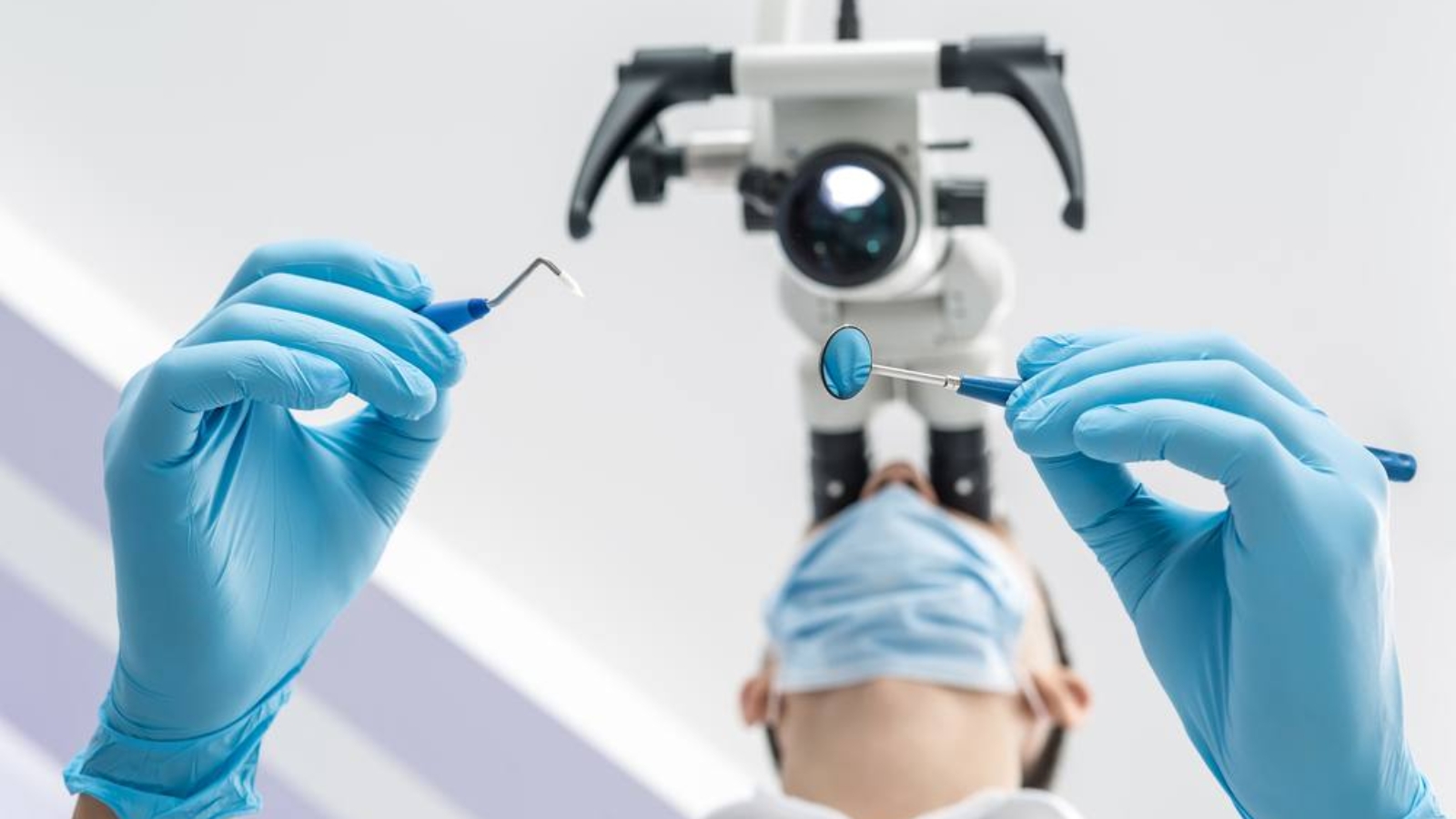
Root canal retreatment is among the most technically demanding procedures in restorative dentistry. Professor Alexander von Breuer notes that the success of secondary endodontic therapy depends not only on the quality of instruments but also on the ability to visually control the smallest anatomical details. At DentalClinic24, microscopic magnification is regarded as a clinical standard for revision procedures, significantly improving precision and increasing the likelihood of preserving the natural tooth even in complex cases.
The need for retreatment most commonly arises from insufficient canal preparation, missed accessory canals, inadequate obturation, or the development of secondary infection. Without optical magnification, such defects may remain undetected. A dental microscope enables identification of microcracks, remnants of previous filling materials, separated instrument fragments, and additional canals that cannot be visualised during conventional examination.
Root canal anatomy is highly variable. Even within the same tooth type, additional canals and curved segments may be present. Under magnification, the clinician can accurately determine canal direction, assess the condition of dentinal walls, and avoid excessive removal of tooth structure. At DentalClinic24, this approach reduces the risk of perforations and iatrogenic complications.
Microscopic control is particularly important during the removal of previous filling materials. Incomplete cleaning of the canal system allows infection to persist and compromises long-term prognosis. Optical magnification makes it possible to monitor each stage of revision – from locating canal orifices to preparing the apical region. This ensures a more predictable outcome and decreases the likelihood of further intervention.
Retreatment is often performed in teeth with already weakened structural integrity. Excessive mechanical force may result in cracks or root fracture. Microscope-assisted techniques allow for more delicate manipulation, minimising tissue trauma. At DentalClinic24, the preservation of natural tooth structure remains a fundamental principle throughout endodontic therapy.
The stage of re-obturation is equally critical. Under magnification, the clinician evaluates the density of filling material adaptation, the absence of voids, and the precision of filling complex anatomical areas. Hermetic sealing directly influences long-term prognosis by preventing reinfection and periapical inflammation.
Microscopic examination also enhances diagnostic accuracy. In some cases, vertical root fractures or resorptive defects become visible only under magnification, rendering tooth preservation impractical. Early identification of such conditions helps avoid unnecessary procedures and supports more rational clinical decision-making.
At DentalClinic24, root canal retreatment under a microscope is considered a comprehensive process that includes evaluation of the previous treatment, assessment of biomechanical integrity, and prediction of future functional load. This integrated strategy not only eliminates infection but also restores structural stability.
For the patient, the use of a dental microscope means a higher level of clinical control and transparency. Every stage of the procedure is performed under enhanced visualisation, reducing the likelihood of error and improving the stability of the outcome. In the long term, this contributes to preservation of the natural tooth and helps prevent the need for more extensive prosthetic or surgical interventions.
Thus, root canal retreatment under a microscope represents not merely a technological advantage but a clinically justified standard of modern endodontics. Optical magnification increases revision accuracy, minimises risks, and improves the prognosis for tooth preservation. At Dental Clinic24, this approach combines technological precision with biological understanding of healing and tissue adaptation.
Previously, we wrote about the longevity of veneers at DentalClinic24 – clinical factors influencing the stability of aesthetic results and the preservation of hard dental tissues.