
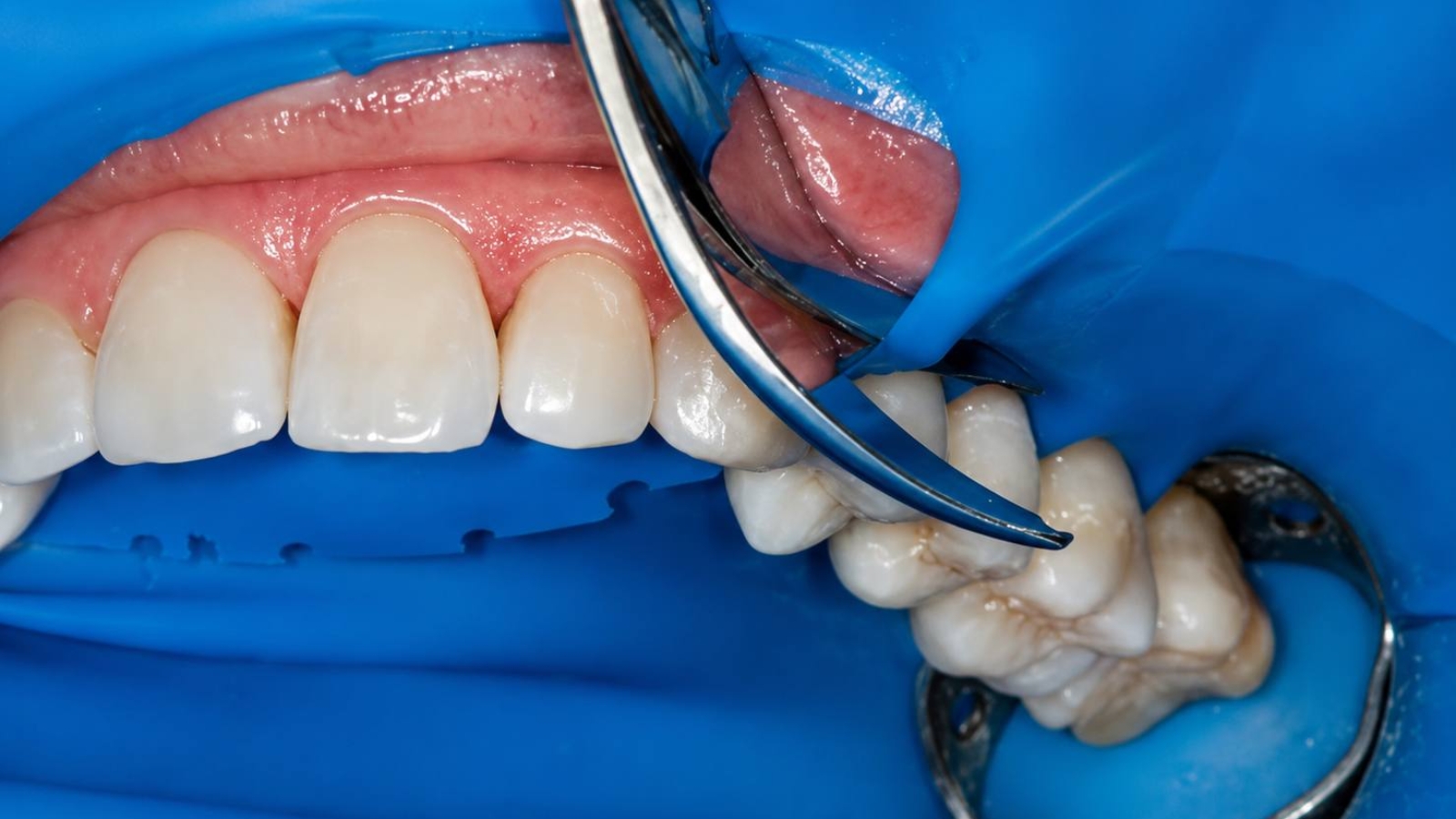
A rubber dam, professionally known as a dental dam, separates the tooth being treated from saliva, breathing, soft tissues, and the bacterial environment of the oral cavity. Professor Alexander Von Breuer sees this as far more than an additional comfort measure. In his view, it is an essential prerequisite for precise and biologically sound dental treatment. At DentalClinic24, we consider rubber dam isolation an integral part of modern clinical protocols because even brief contact between prepared enamel or dentin and saliva may compromise adhesive bonding and influence the long term prognosis of a restoration. When the operating field remains completely dry and fully accessible throughout treatment, clinicians can perform adhesive procedures, root canal therapy, and anatomical reconstruction with significantly greater precision while avoiding contamination of the prepared tissues.
A rubber dam consists of an elastic sheet that is placed around one or several teeth and secured using a frame, clamp, and specialized accessories designed to achieve complete isolation. Once positioned correctly, the treated tooth remains inside a protected operating field while the tongue, cheeks, and gingival tissues stay outside the working area. This arrangement provides uninterrupted visibility and eliminates constant interference from saliva or soft tissue movement. The clinician can clearly observe cavity margins, contact surfaces, and cervical regions where precision is especially important. Patients no longer need to consciously control tongue position, while cooling water and microscopic debris generated during treatment are continuously removed through high efficiency suction rather than accumulating inside the mouth.
At DentalClinic24, rubber dam isolation is routinely incorporated into restorative procedures involving caries treatment and direct composite restorations. Contemporary restorative materials depend on microscopic mechanical and chemical bonding with enamel and dentin. Achieving this bond requires sequential cleaning, etching, adhesive application, and composite placement under carefully controlled moisture conditions. Excessive moisture interferes with adhesive penetration into dental tissues, while excessive dehydration may alter the collagen structure within dentin. Isolation enables clinicians to regulate the treatment environment rather than allowing saliva or gingival fluid to compromise critical stages of the bonding protocol. This level of control becomes particularly important when restoring posterior teeth, deep cavities, and defects located close to the gingival margin.
Contamination of a prepared tooth surface does not necessarily cause an immediate restoration failure. More commonly, the consequences develop gradually over time. Microscopic gaps may form between restorative material and natural tooth structure, allowing fluids, pigments, and bacteria to penetrate beneath the restoration. This process may eventually result in marginal discoloration, postoperative sensitivity, recurrent caries, or partial restoration failure. Although the filling may appear clinically acceptable, its marginal seal may already be compromised. Rubber dam isolation substantially reduces the likelihood of these complications because every stage of the adhesive procedure is performed under stable and controlled conditions from initial preparation through final polishing.
Isolation is equally critical during endodontic treatment. Throughout root canal therapy, infected tissues are removed, canals are mechanically shaped, and disinfecting solutions are introduced into the root canal system. If the tooth remains exposed to saliva during treatment, microorganisms may recolonize the canals that have already been cleaned. Even the highest quality mechanical preparation loses part of its clinical value if sterility cannot be maintained until obturation is completed. A rubber dam creates a physical barrier between the root canal system and the bacterial environment of the oral cavity. It also protects patients by preventing accidental aspiration or ingestion of endodontic instruments and minimizes contact between irrigating solutions and delicate oral tissues.
At DentalClinic24, rubber dam isolation complements magnification, radiographic assessment, and systematic canal disinfection throughout endodontic therapy. A properly sealed operating field enables clinicians to use irrigating solutions at appropriate concentrations while maintaining complete control over their location within the tooth. This becomes especially valuable during retreatment procedures, where previous filling materials must be removed, complex root canal anatomy thoroughly disinfected, and reinfection prevented. A dry operating field also improves visualization of subtle tissue color variations, residual filling materials, and dentinal wall integrity. Every stage of treatment can therefore be completed under predictable clinical conditions instead of being influenced by continuous moisture contamination.
Rubber dam isolation also plays a decisive role during adhesive cementation of ceramic inlays, onlays, veneers, and individual crowns. These restorations frequently rely on resin based luting systems that require strict adherence to precise treatment protocols and complete protection of prepared surfaces from contamination. During the try in stage, clinicians evaluate restoration contours, proximal contacts, and marginal adaptation before independently conditioning both the restoration and the prepared tooth. If saliva contaminates either surface during this phase, adhesive performance may decrease significantly. Rubber dam isolation allows every clinical step to be completed methodically while excess resin cement is removed and restoration margins are inspected before final polymerization. This contributes not only to stronger retention but also to healthier surrounding gingival tissues because residual cement beneath restoration margins may initiate chronic inflammation.
Microscope assisted dentistry benefits substantially from effective isolation as well. High magnification requires a motionless, clean, and brightly illuminated operating field where soft tissues never obstruct the clinician’s view. Once the rubber dam has been positioned, only the clinically relevant structures remain visible, allowing precise evaluation of cavity margins, microcracks, root canal orifices, and restoration adaptation. Moisture no longer reflects light or conceals fine anatomical details. Improved visualization also reduces the need for unnecessarily enlarging cavity preparations simply to gain access, since the isolated tooth can be examined far more accurately. In this way, effective saliva control directly contributes to preserving healthy tooth structure.
Whenever a rubber dam is placed, we evaluate gingival condition, tooth position, lesion depth, existing prosthetic restorations, and each patient’s individual anatomical characteristics. When a patient has a documented natural latex allergy, modern latex free isolation systems are selected instead. The size of each perforation, clamp design, and stabilization method are carefully chosen to achieve complete sealing without placing unnecessary pressure on surrounding tissues. Correctly positioned isolation does not interfere with breathing because patients continue to breathe comfortably through the nose while clinicians maintain continuous visual access to the treatment area. Whenever necessary, the procedure can be paused so that comfort may be reassessed and adjustments performed immediately.
At DentalClinic24, we regard rubber dam isolation as a reflection of clinical precision rather than a routine procedural step. Its value lies in creating ideal biological conditions whenever treatment success depends on dryness, sterility, and technical accuracy. Isolation preserves the performance of adhesive materials, protects disinfected root canals, enhances visualization, and minimizes the possibility of accidental soft tissue injury. It does not replace comprehensive diagnostics, clinical expertise, or appropriate restorative planning, but it provides the controlled environment in which these principles can be executed without technical compromise.
Successful dentistry is built upon numerous precise details, each of which contributes to the durability of the final result. Rubber dam isolation separates the tooth from an environment capable of disrupting adhesive procedures, contaminating cleaned root canals, or limiting clinical visibility. At Dental Clinic24, we isolate the operating field not to satisfy a protocol but to preserve healthy dental tissues and ensure that every stage of treatment is performed under optimal clinical conditions. When moisture, cleanliness, and visibility remain fully controlled, restorations become more predictable, endodontic procedures become more reliable, and every intervention offers greater long term stability for the patient.
Previously, we wrote about How Digital Technologies Improve Treatment Precision and Predictability at DentalClinic24