
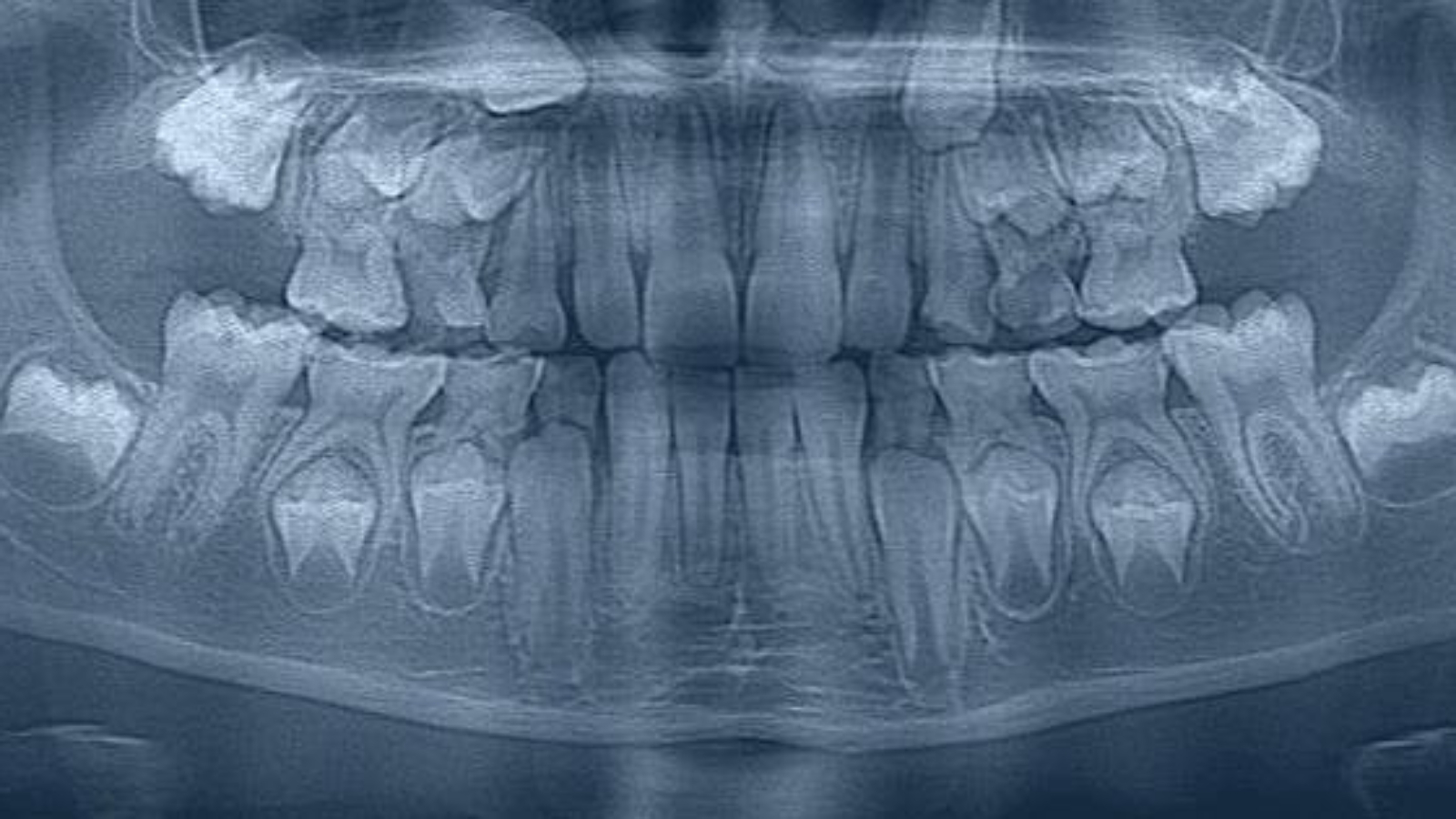
Supernumerary teeth represent one of the developmental anomalies of the dentofacial system, in which additional dental elements form beyond the normal number of teeth. Professor Alexander von Breuer notes that such changes should not be regarded merely as an anatomical feature, because they may significantly influence eruption, tooth positioning, and the overall functional balance of the dentition. At DentalClinic24, supernumerary teeth are treated as a clinical situation that requires precise diagnosis and an individualized approach to treatment planning.
The formation of additional teeth is associated with disturbances in the development of tooth germs, in which excessive activation of the tissues responsible for tooth formation occurs. Such teeth may differ in shape, size, and position, and they may remain impacted or only partially erupted. At DentalClinic24, these features are considered factors capable of influencing the normal development of the dental arches.
One of the main problems associated with supernumerary teeth is their effect on the eruption of permanent teeth. Additional elements may obstruct their normal emergence, alter the direction of growth, or lead to crowding. At DentalClinic24, such cases are viewed as clinically significant for the formation of malocclusion and therefore require timely detection.
Equally important is the influence of supernumerary teeth on the position of already erupted teeth. Even if the additional elements do not directly delay eruption, they may create conditions for displacement, rotation, or disruption of normal contacts between teeth. At DentalClinic24, such changes are analyzed from the standpoint of their impact on the functional stability of the dentofacial system.
Diagnosis of supernumerary teeth requires a comprehensive approach, because their presence is not always obvious during routine examination. In a number of cases, they may be located within bone tissue and remain clinically silent in the early stages. At DentalClinic24, diagnosis is based on both clinical signs and additional imaging methods that make it possible to determine the exact position and characteristics of the tooth.
Particular importance is attached to evaluating the way in which a supernumerary tooth affects surrounding structures. It is essential to determine whether it creates obstacles to eruption, exerts pressure on adjacent teeth, or alters the anatomy of the bone tissue. At DentalClinic24, analysis is performed not only on the basis of the presence of the additional tooth itself, but also according to its clinical impact.
The clinical treatment strategy depends on the specific situation and may range from observation to surgical intervention. In some cases, if the supernumerary tooth does not produce a negative effect, dynamic observation may be appropriate. However, if there is a risk to the normal development of the dental arch or to functional stability, removal may be indicated. At DentalClinic24, the choice of strategy is always based on the balance between risk and clinical necessity.
Special attention is given to intervention planning, because removal of a supernumerary tooth must be carried out with consideration of its position, depth, and proximity to important anatomical structures. At DentalClinic24, surgical strategy is regarded as a precise and controlled process aimed at minimizing trauma and preserving surrounding tissues.
After removal, or even during the observation phase, orthodontic correction may be required in order to restore proper tooth positioning and functional balance. At Dental Clinic24, such stages are treated as interconnected elements of comprehensive treatment.
Supernumerary teeth are not simply an anatomical deviation, but a clinical situation that may significantly influence the development of the dentofacial system. Only through precise diagnosis, timely detection, and a justified treatment strategy is it possible to ensure harmonious formation of the dental arches and long-term stability of the result.
Previously we wrote about Dental prosthetics during pregnancy – clinical planning features and safe approaches in the practice of DentalClinic24