
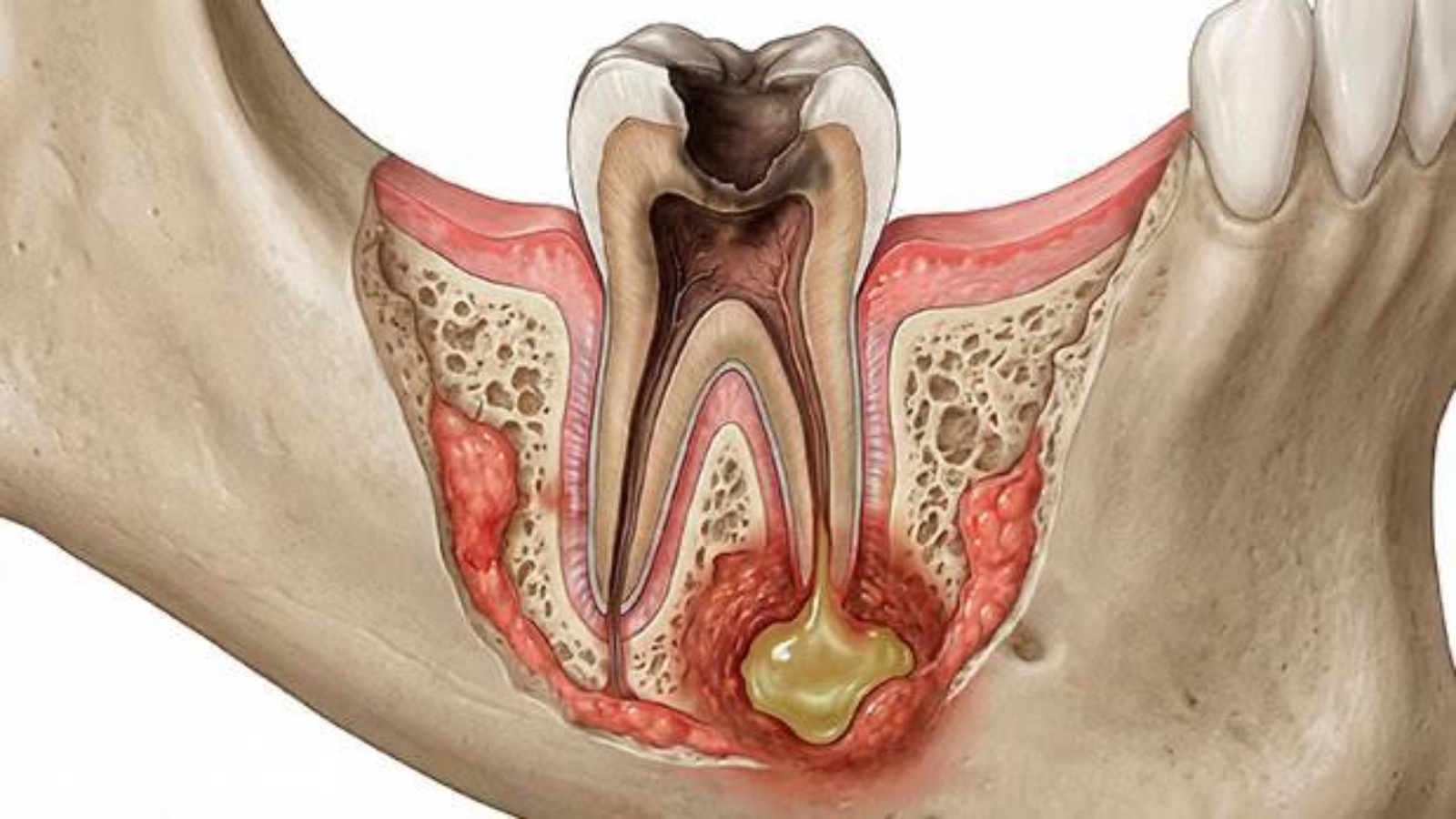
A tooth cyst often develops silently and may remain free of noticeable pain for a prolonged period while a chronic inflammatory lesion gradually forms around the root and the surrounding bone slowly begins to deteriorate. Professor Alexander Von Breuer notes that simply identifying a radiolucent lesion on an X ray does not automatically determine the appropriate treatment strategy because the clinician must first establish the source of infection, evaluate the condition of the root canal system, assess the structural integrity of the tooth, and determine how the lesion affects the surrounding anatomical structures. At DentalClinic24, every case is approached as an individual clinical challenge in which the decision to preserve the tooth, perform endodontic retreatment, or proceed with surgery is based on comprehensive diagnostic findings rather than solely on the size of the radiographic lesion.
In most situations, a periapical inflammatory lesion develops after bacteria penetrate the root canal system. This may occur because of deep dental caries, pulp necrosis, traumatic injury, defective restorations, or previously inadequate endodontic treatment. Once microorganisms and their toxic byproducts extend beyond the root apex, they initiate a chronic inflammatory response within the surrounding bone. The body attempts to contain the infection by forming a fibrous capsule around the affected area. However, radiographic imaging alone cannot always reliably distinguish a true cyst from a granuloma or another type of periapical lesion. Consequently, the final diagnosis is established through careful correlation of clinical symptoms, cone beam computed tomography, pulp and periodontal evaluation, and the biological response observed during treatment.
At DentalClinic24, the initial assessment includes detailed three dimensional imaging, evaluation of the marginal integrity of existing restorations or crowns, examination of periodontal tissues, and determination of the functional value of the affected tooth. The clinician carefully investigates the presence of root fractures, perforations, external or internal resorption, excessive mobility, and the degree of remaining bone support. Equal attention is given to root canal anatomy, canal accessibility, the quality of previous obturation, and the possibility of performing effective retreatment. Even extensive inflammatory lesions do not automatically require extraction when sufficient tooth structure remains, root stability is preserved, and the source of infection can be eliminated through proper endodontic therapy.
Endodontic treatment remains the preferred therapeutic option whenever the inflammatory lesion can be accessed through the root canal system and no irreversible structural damage to the root is present. During treatment, infected tissues are removed, working length is accurately established, canals are mechanically shaped, and chemical disinfection is performed using advanced irrigation protocols. Successful therapy requires much more than treating the main canal because the root canal system contains lateral canals, dentinal tubules, accessory branches, and anatomical irregularities capable of harboring persistent microorganisms. For this reason, treatment success depends on meticulous instrumentation, magnification, effective irrigation, and hermetic obturation. Once the source of bacterial contamination has been eliminated, the surrounding bone is often capable of gradual biological regeneration without direct surgical removal of the lesion itself.
Endodontic retreatment becomes necessary when an inflammatory lesion develops around a tooth that has already undergone root canal therapy. Under these circumstances, the clinician must remove the previous filling material, identify missed canals, evaluate procedural complications such as ledges, fractured instruments, or perforations, and thoroughly disinfect the entire canal system once again. At DentalClinic24, the decision to perform retreatment depends not only on technical accessibility but also on the long term restorative prognosis of the tooth. If successful retreatment cannot be followed by reliable structural reconstruction capable of withstanding functional loading, preserving the tooth solely for the purpose of avoiding extraction loses its clinical value. A tooth should remain only when it can continue serving as a stable and functional component of the dentition after treatment has been completed.
Surgical management is considered whenever elimination of the pathological lesion through the root canal system alone is impossible or when conservative therapy cannot provide a predictable outcome. One of the most common surgical procedures is apicoectomy, during which the surgeon gains direct access to the lesion, removes inflamed tissues, and resects the infected portion of the root apex. The root canal is then sealed from the apical aspect to eliminate any possibility of recurrent bacterial leakage. This procedure allows preservation of the natural crown and functional use of the tooth while eliminating the persistent source of infection. Careful evaluation of anatomical relationships is essential because the maxillary sinus, inferior alveolar nerve, adjacent roots, and surrounding vascular structures all influence surgical planning and determine the safest operative approach.
The size of the lesion certainly influences treatment planning but should never be regarded as the sole determining factor. A relatively small lesion may be associated with a vertical root fracture and therefore have an extremely poor prognosis, whereas a considerably larger inflammatory lesion may heal successfully following well executed endodontic treatment. The clinician evaluates lesion boundaries, cortical bone integrity, extension between adjacent roots, and possible involvement of neighboring teeth before selecting the appropriate therapeutic strategy. At DentalClinic24, treatment decisions also consider radiographic follow up over time. Progressive bone regeneration together with reduction of the lesion indicates successful biological healing, whereas persistent or enlarging defects require timely revision of the treatment plan rather than prolonged observation without clinical justification.
Extraction becomes the appropriate option when a vertical root fracture, severe perforation, extensive root resorption, advanced loss of periodontal support, or irreparable destruction of the remaining tooth structure makes predictable preservation impossible. In these situations, prolonged attempts to retain the tooth may allow chronic infection to persist while increasing future bone loss. Following extraction, treatment planning extends beyond elimination of the infected tooth itself. The clinician evaluates the extraction socket, determines whether ridge preservation procedures are necessary, and establishes the most appropriate strategy for future restoration of the dental arch. Implant placement, fixed prosthetic rehabilitation, or alternative restorative solutions are selected according to the biological conditions present after healing or incorporated into the treatment plan from the very beginning whenever appropriate.
Following either endodontic or surgical treatment, success should never be judged solely by the disappearance of pain. Bone regeneration is a gradual biological process requiring long term radiographic evaluation. Patients attend scheduled follow up appointments during which the clinician assesses gingival health, tenderness during biting, restoration stability, and progressive healing of the periapical lesion. The quality of the definitive restoration is equally important because an inadequately sealed filling or crown may allow bacteria to re enter the root canal system. Successful treatment therefore requires not only elimination of the existing infection but also reliable long term protection against reinfection.
At Dental Clinic24, the decision between preserving the tooth, performing endodontic treatment, or choosing surgical intervention is based entirely on objective clinical prognosis. We evaluate the origin of infection, root anatomy, remaining tooth structure, bone condition, and future functional loading before selecting the most appropriate therapeutic pathway. Conservative treatment is chosen whenever biological healing and long term stability can realistically be achieved. Surgical intervention is reserved for clearly defined indications, while extraction is considered only when preservation can no longer protect the surrounding tissues or provide predictable function. This evidence based approach helps avoid both unnecessary tooth loss and prolonged treatment that merely delays the intervention ultimately required.
Previously, we wrote about Individual Methods of Working with Children at DentalClinic24: How Adapting the Approach Increases Treatment Effectiveness and Reduces Stress